
Celestial Symphony: Six Planets in Sync On Feb 28, 2026
No telescope needed for the bright ones—witness the cosmic arc that's got stargazers buzzing worldwide.

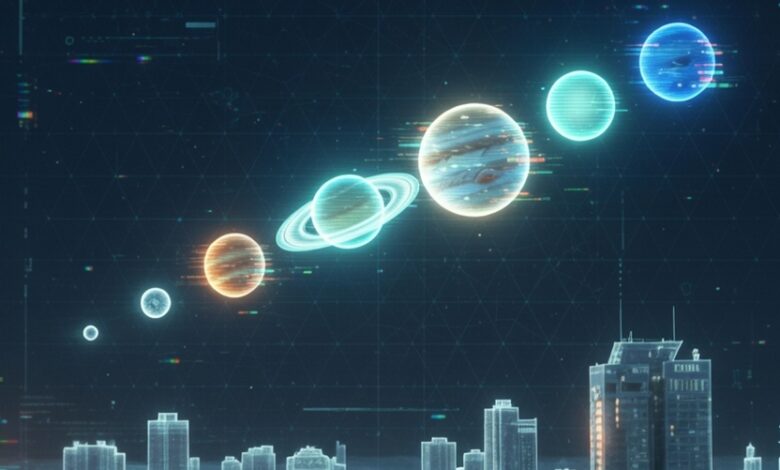
Celestial Symphony: Six Planets in Sync On Feb 28, 2026. As the sun dips below the horizon on February 28, 2026, sky watchers around the world will be treated to a rare cosmic spectacle: a six-planet alignment, often dubbed a “planetary parade.” This event, visible shortly after sunset, features Mercury, Venus, Saturn, Jupiter, Uranus, and Neptune stretching across the evening sky in a graceful arc. From Mumbai to New York, observers in clear conditions can witness this alignment, a reminder of our place in the vast solar system. Unlike dramatic eclipses or meteor showers, this quiet convergence highlights the subtle dance of celestial bodies.

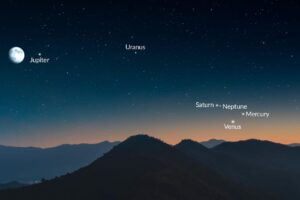
The turn of events begins in the western sky, where Mercury and Venus huddle low near the horizon, their glow fading quickly into twilight. Moving eastward, Saturn appears next, followed by the faint blue dots of Neptune and Uranus—requiring binoculars or a telescope for visibility. High in the southeast, mighty Jupiter shines brightly, anchoring the lineup. This configuration isn’t a sudden occurrence but the culmination of orbital paths aligning from Earth’s vantage point.
BY – http://indianiput.com Desk
As planets orbit the Sun at varying speeds—Mercury zipping around in 88 days, while Neptune takes 165 years—they periodically appear to line up along the ecliptic, the imaginary plane of Earth’s orbit projected onto the sky. In late February 2026, the inner planets catch up with the outer giants, creating this temporary harmony.
Mark Your Calendars !
FEBRUARY 28, 2026
Don’t forget to look up the planets will drift quietly across the sky, reminding us how beautifully the universe can align. pic.twitter.com/TTShFgFyQM— A Man Of Memes (@RickyDoggin) February 23, 2026
The reason behind this marvel lies in basic astronomy: it’s an optical illusion. Planets don’t physically cluster; they’re millions of kilometers apart. Yet, from our perspective, their positions coincide, much like distant streetlights appearing in a row. Such alignments of six planets are uncommon, occurring every few years, but this one is special due to its evening visibility without early morning wake-ups. Factors like a nearly full Moon at 90.6% illumination may dim fainter planets, so seek dark skies away from city lights for the best view.
For Earthlings, this is more than science—it’s a marvel of wonder. Imagine gazing up at worlds that have inspired myths and missions: Venus, the evening star; Jupiter, king of planets with its stormy atmosphere; distant Neptune, a icy giant. No special equipment is needed for the brighter ones—Venus at magnitude -3.9 outshines everything but the Moon. Start observing 30-60 minutes after sunset, facing west, and scan the arc with apps like Star Walk for guidance.
This alignment evokes the quiet beauty of the cosmos, a fleeting moment where the universe seems ordered and accessible. As social media buzzes with anticipation, from X posts to global stargazing parties, it unites us in awe.
Don’t miss it, mark your calendars, Readers and let the stars align your night.
FEEDBACK : contact @indiainput.com
SOURCE :
https://science.nasa.gov/solar-system/whats-up-february-2026-skywatching-tips-from-nasa
https://starwalk.space/en/news/planetary-alignment-february-28-2026
CATCHUP FOR MORE ON : http://indiainput.com
Sindhudurg: The Sea Fort That Bears Shivaji’s Soul !
जड़ें मजबूत रखो, भाषा से शुरू करो! घर में मातृभाषा बोलो ।
Modi’s Cattle AI Brainwave: Sarlaben App in Record Time
PM Modi’s Alarm: Make AI Child-Safe — Starting Today
Why Macron Says India Will Own the AI Future