Colors That Heal: Holi’s Triumph of Love and Light!
A festival that burns evil, blooms spring, and bonds souls!

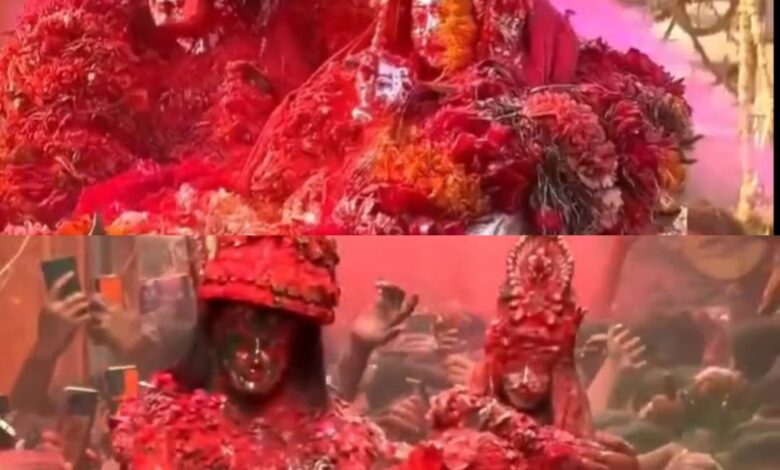
Colors That Heal: Holi’s Triumph of Love and Light! Holi, the vibrant Festival of Colors, is one of India’s most joyous Hindu celebrations, marking the arrival of spring, the triumph of good over evil, and the renewal of life. Celebrated on the full moon of Phalguna (usually March), it brings communities together in an explosion of color, music, and merriment.
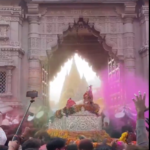
The festivities begin with Holika Dahan the night before, where bonfires symbolize the burning of negativity, ego, and evil, are calling the legend of Prahlad and the demoness Holika. The next day, Rangwali Holi or Dhulandi unleashes playful chaos: people smear and throw gulal (colored powders) and splash colored water on one another, erasing social barriers in laughter and forgiveness.
By – http://indiainput.com Desk.
Colors carry deep meaning : red for love, blue for Lord Krishna, green for new beginnings, yellow for prosperity. Rooted in stories of Krishna’s playful Leela with Radha and the gopis, Holi fosters unity, letting inhibitions fade as strangers become friends amid thandai, gujiya sweets, folk songs, and dances.
A large number of devotees are celebrating Holi Utsav at Shri Banke Bihari Mandir in Vrindavan, Uttar Pradesh.#Mathura #Holi2026 #Holi pic.twitter.com/8bAscTRL69
— Organiser Weekly (@eOrganiser) February 27, 2026
#BankebiharikiHoli
In Mathura and Vrindavan (Braj region), Holi is intensely devotional and extended, with temple rituals at Banke Bihari Mandir where priests shower gulal on crowds, evoking Krishna’s divine play. Multi-day festivities draw millions, blending color, bhajans, and legendary energy.
Rangbhari Ekadashi in Kashi
Where Mahadev celebrates in colors,
three days of divine Holi Mahotsav.Har Har Mahadev ✨ pic.twitter.com/y2h4VORFUg
— Akanksha Parmar (@iAkankshaP) February 27, 2026
#MasanekiHoli
In Varanasi (Kashi), Rangbhari Ekadashi (Amalaki Ekadashi, observed on February 27, 2026) marks the pious start of Holi Mahotsav. At Kashi Vishwanath Temple, devotees offer gulal to Lord Shiva and Parvati, with colorful processions signaling divine celebration and harmony.
This day commemorates Lord Shiva’s return to Kashi with Goddess Parvati after their celestial wedding, blending Shaiva and Vaishnava traditions.
VIDEO | Thousands gather at Varanasi’s Harishchandra Ghat to play ‘Masane ki Holi’ with pyre ash amidst burning pyres.#MasanekiHoli #Holi #Varanasi
(Full video available on PTI Videos – https://t.co/n147TvrpG7) pic.twitter.com/oxM7bR6PKr
— Press Trust of India (@PTI_News) February 27, 2026
At Kashi Vishwanath Temple, devotees offer gulal and abir in special rituals, with colorful processions, dhol beats, and mantras creating an atmosphere of divine reunion and harmony. It signals the onset of Holi Mahotsav, where colors symbolize love and spiritual joy, often extending into unique observances like Masan Holi near ghats.
Holi ho to Vrindavan Jaisi 🤌🏻😍 pic.twitter.com/AEaEcjOFB1
— Radhika Ras 🪷 (@GitaInspire) February 26, 2026
Kumaoni Holi
India’s regional variations enrich its essence. In Uttarakhand’s Kumaon hills, Kumaoni Holi unfolds as a disciplined, music-centered tradition spanning nearly two months from Basant Panchami to Phalguna Purnima.
It features three forms : Baithki Holi (seated devotional singing in classical ragas like Yaman or Bhimpalasi in temple courtyards), Khadi Holi (standing rhythmic group songs and dances in village squares with hurka and dhol), and Mahila Holi (women-led creative performances).
Focused on devotion, dignity, and intergenerational transmission, it remains pure tradition without chaos—surviving through community belief and now seeking greater preservation, including UNESCO recognition.
Kumaoni Holi is not just a celebration. It is identity, memory and music carried through generations in the hills of Uttarakhand.
In villages across Kumaon, Holi is sung in classical ragas. It is performed sitting in temple courtyards, standing in village squares, led by elders… pic.twitter.com/7P9BvrFXud
— Kumaon Jagran (@KumaonJagran) February 27, 2026
In 2026, amid slight regional variations due to lunar alignments and a lunar eclipse influence, Holika Dahan falls around March 2-3, with main Holi on March 3-4.
These diverse expressions from Kumaon’s melodic restraint to Mathura’s playful devotion and Kashi’s sacred ecstasy highlight Holi’s timeless message: joy, renewal, and unity.
As modernization threatens traditions, preserving them ensures future generations inherit this profound cultural soul.
SOURCE :
FEEDBACK : contact@indiainput.com
CATCHUP FOR MORE ON : http://indiainput.com
#Modi Mania Goes Global: The People’s Statesman !
#Punch the Monkey: Google Rains Hearts for This Viral Baby !!
#Punch the Monkey: Google Rains Hearts for This Viral Baby !!
Fingers Snapped! Wednesday Season 3 Awakens From The Crypt!!
Fingers Snapped! Wednesday Season 3 Awakens From The Crypt!!
#keepgoingpunch #कीपगोइंगपंच : … लेकिन उम्मीद बाकी !
Celestial Symphony: Six Planets in Sync On Feb 28, 2026