
Toll Wars @Sea: Who Controls the World’s النفط Oil Lifeline?
As tensions rise, the world’s busiest oil route is turning into a high-stakes geopolitical checkpoint.

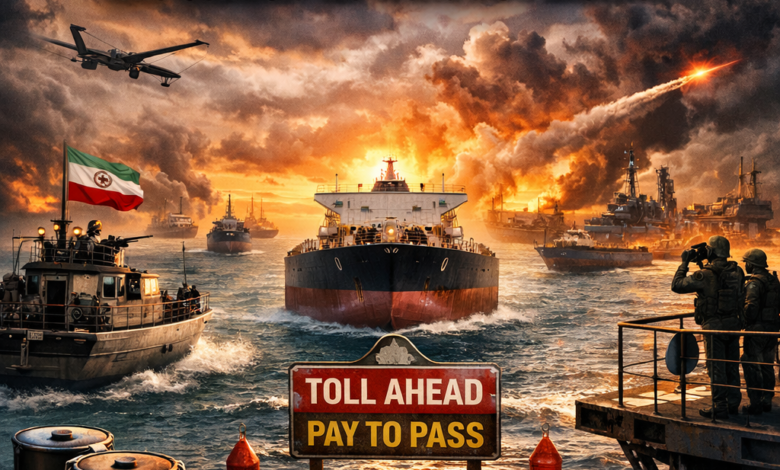
Toll Wars @Sea: Who Controls the World’s النفط Oil Lifeline? The world’s energy supply doesn’t just depend on oil reserves—it depends on who controls the routes that move it. At the center of this high-stakes equation lies the Strait of Hormuz, a narrow maritime corridor that has suddenly become the focal point of a new kind of conflict: one where ships are no longer just passing through, but negotiating their way across.
Free navigation
Stretching between the Persian Gulf and the Arabian Sea, the Strait of Hormuz handles nearly a fifth of global oil shipments.
By_http://indiainput.com Desk
For decades, it symbolized the principle of free navigation under international maritime law. But ongoing tensions in the Middle East have begun to challenge that assumption, turning open waters into contested territory.
From Free Passage to “Pay-to-Sail”
Recent developments suggest a shift from passive control to active enforcement. Reports and signals from regional powers indicate that commercial vessels—especially oil tankers—are being subjected to new forms of pressure.
- Iran has proposed and in some cases reportedly enforced transit fees, with figures reaching up to $2 million per vessel.
- Ships are being routed through Iran-controlled corridors, often requiring prior approval and coordination.
- Payments are sometimes framed as “security fees” for safe passage amid mine threats and military tension.
While not universally enforced, the very idea of charging ships to cross a natural strait has sent shockwaves through the global shipping industry.
BREAKING 🚨
⛴️ 🇮🇷 Iran is now restricting Strait of Hormuz transits to just ~12 ships per day and demanding tolls paid in cryptocurrency or Chinese yuan — even under the fragile US-Iran ceasefire, per WSJ reporting.https://t.co/JYaS84bJk7
— GLOBAL NEWS (@MohiniWealth) April 9, 2026
Middle East Shipping a Geopolitical Bargaining Chip?
Critics, however, see something more troubling: the weaponization of geography. Under international law, straits like Hormuz are meant to remain open to all vessels in transit.
Introducing tolls risks setting a dangerous precedent—one where strategic chokepoints become tools of economic coercion. If normalized, similar practices could emerge in other critical routes, from Southeast Asia to the Mediterranean.
Maritime blackmail ?
The impact is already being felt.
- Thousands of ships and seafarers are stranded or rerouted.
- Daily traffic has dropped drastically from 100+ ships to just a handful.
- Insurance costs have surged, making transit economically risky.
Some vessels are choosing longer, more expensive journeys to avoid uncertainty, while others remain stalled, waiting for clarity in an increasingly unpredictable environment.
Global Pushback
Beyond economics, the situation underscores a deeper geopolitical reality: control over supply chains is as powerful as control over resources. Oil-producing nations may hold the reserves, but transit nations and regional powers can influence how—and whether—that oil reaches the world.
The question, then, is no longer just about النفط (crude oil in Arabic) or navigation. It’s about leverage. In a world where energy security is tightly linked to political stability, the Strait of Hormuz has become more than a passage—it is a pressure point.
As tensions simmer, one thing is clear: the battle for global influence is no longer confined to land or air. It is unfolding at sea, where every passing tanker carries not just fuel, but the weight of geopolitics.
SOURCE :
http://UN Ocean Affairs & Law of the Sea Portal
http://IMO Statement on Strait of Hormuz
http://United Nations Convention on the Law of the Sea (Full Text)
FEEDBACK : contact@indiainput.com
CATCHUP FOR MORE ON : http://indiainput.com
Nagpur Teachers’ Census Nightmare #PrivateSchoolsRevolt
#Startup Mela : Nagpur’s own Startup Conclave is here..!
Same Spell, New Story? Harry Potter Series Teaser Splits Fans
Same Spell, New Story? Harry Potter Series Teaser Splits Fans