Who Gets to Judge India? USCIRF Report Sparks RSS Debate!!
As Washington debates policy, Indian voices argue the country needs no lessons on pluralism.

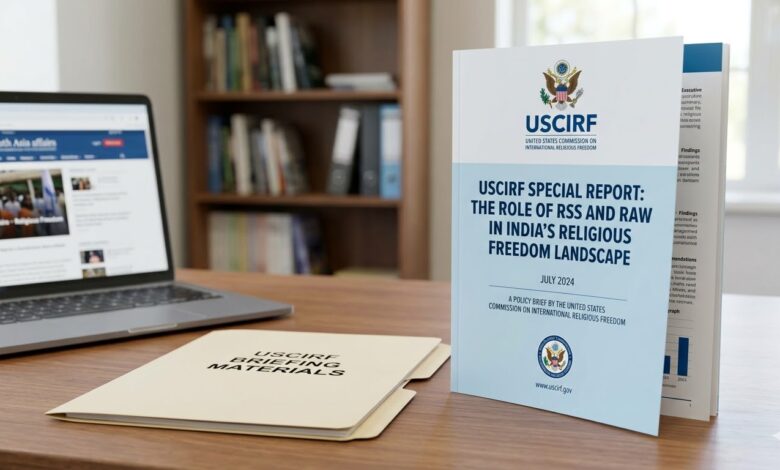
Who Gets to Judge India? USCIRF Report Sparks RSS Debate. A fresh debate has erupted after the United States Commission on International Religious Freedom (USCIRF) recommended that the United States government designate India as a “Country of Particular Concern” over issues related to religious freedom.



The commission further suggested that Washington consider linking defence cooperation and trade engagement with religious freedom benchmarks. The recommendation, reportedly directed toward the administration of Donald Trump, has triggered sharp reactions across sections of India’s political and social landscape.
By_http://indiainput.com desk.
Myopic/Biased report
The report truly hints a biased view to India’s religious freedom landscape. Many observers in India view the recommendation as an example of Western institutions attempting to evaluate complex social realities through a narrow lens.
Critics argue that such reports often overlook India’s constitutional framework, its democratic institutions, and the long history of coexistence among multiple faiths.
In a country that is home to nearly every major religion in the world, supporters say the conversation on religious freedom cannot be simplified into external labels or rankings.
1. The Indian National Congress has once again amplified anti-India propaganda by peddling the USCIRF 2026 Annual Report, which calls for sanctions on RSS and R&AW. This isn’t new. INC has long been a habitual promoter of PAKISTANI & ISI propaganda in India.
1/9 pic.twitter.com/QvWSUj4cvk
— The Chronology (@TheChronology__) March 16, 2026
Nationalism !
The debate has also brought renewed attention to the role of the Rashtriya Swayamsevak Sangh (RSS), one of India’s most influential socio-cultural organizations. Founded in 1925, the RSS describes itself as a volunteer-based movement focused on social service, national unity, and cultural awareness.
Its supporters argue that the organization’s thousands of volunteers work quietly across the country in disaster relief, rural development, and educational initiatives aimed at strengthening social cohesion.
The US Commission on International Religious Freedom (USCIRF) has made several recommendations regarding India in its latest report.
▪️ Called for targeted sanctions against RSS and India’s intelligence agency RAW
▪️ Suggested the US halt arms sales to India, citing alleged… pic.twitter.com/TIGloBi5eA— Geo Sync (@thegeo_sync) March 16, 2026
From this perspective, the criticism emerging from international bodies like USCIRF is seen by many as ignoring grassroots realities and the voluntary work carried out by organizations embedded deeply within Indian society. Supporters of the RSS say the organization represents a form of disciplined nationalism rooted in service rather than political power.
USCIRF an “entity of concern”- Indians respond !
Critics say the United States Commission on International Religious Freedom (USCIRF) has lost credibility due to what they describe as politically driven reports on India. In response, voices in India argue that the commission itself should be treated as an “entity of concern,” claiming its recommendations often reflect selective scrutiny.
They point out that the USCIRF has called for action against organizations such as the Rashtriya Swayamsevak Sangh (RSS) and even raised concerns about India’s intelligence agency, Research and Analysis Wing (RAW).
Critics further argue that the commission’s reports highlight India while rarely focusing on alleged human-rights controversies linked to intelligence agencies like the Central Intelligence Agency (CIA) or Inter-Services Intelligence (ISI). Questions have also been raised about the composition of the commission and whether it reflects global religious diversity.
At the same time, advocates of international monitoring insist that global institutions such as USCIRF exist to highlight concerns about religious freedom wherever they arise. In their view, international scrutiny is part of the broader rules-based order meant to encourage accountability among all nations.
Ultimately, the controversy highlights a deeper question: who has the authority to judge a diverse democracy like India?
As the debate intensifies, it reflects the ongoing tension between national sovereignty and international oversight in an increasingly interconnected world.
Source :
http://United States Commission on International Religious Freedom –
https://www.uscirf.gov/countries/india
FEEDBACK : contact @indiainput.com
CATCHUP FOR MORE ON : http://indiainput.com
Red Hat, Global Chase :The Evolution of Carmen Sandiego
SRH’s Hundred Pick Triggers #BoycottSRH Storm in India
Robust LPG Supply Chain Keeps Kitchens Running