Garuda : From Scrap to Sci-Fi, Wings of the Future
AI-Powered Electric Superbike Soaring Beyond Limits

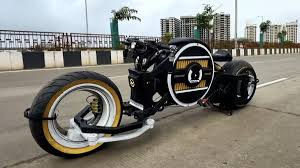
Garuda : From Scrap to Sci-Fi, Wings of the Future. Garuda, named after the mythical divine bird the vehicle(vahana) of Lord Vishnu in Hindu mythology symbolizing power and vision, is a groundbreaking prototype electric superbike developed by three mechanical engineering students—Shivam Maurya, Gurpreet Arora, and Ganesh Patil—from Bhagwan Mahavir University in Surat, Gujarat.
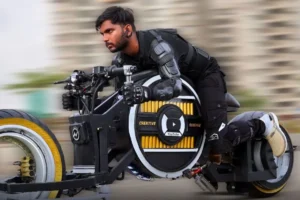
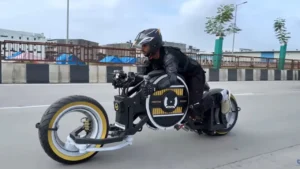
Inspired by Tesla’s autonomous technology, the trio spent a year and approximately ₹1.8 lakh to create this AI-enabled vehicle, remarkably constructing nearly 50% of it from scrap materials like discarded metal parts and repurposed components. This “waste-to-best” approach not only kept costs low but also embodies frugal innovation.
By- Dr. Namrata Mishra Tiwari, Chief Editor https://indiainput.com
At its core, Garuda uses a Raspberry Pi as its “brain,” integrated with sensors, front and rear cameras, and Wi-Fi connectivity for voice commands. Key features include automatic obstacle detection (slowing down at 12 feet and stopping at 3 feet), a touchscreen dashboard for GPS navigation, music playback, and calls, plus wireless phone charging. The lithium-ion battery offers a respectable 220 km range in eco mode (160 km in sport mode) and charges fully in just two hours—faster than many commercial electric two-wheelers.
🚵 Meet Garuda — India’s first AI bike built from 50% scrap! 💡
Created by three students inspired by Tesla, this ₹1.8L marvel can think, respond, and act in real time. From auto road-mapping to pothole detection, it’s packed with GPS, sensors, wireless charging & a 220 km… pic.twitter.com/UHURJVdgUn
— The Better India (@thebetterindia) December 27, 2025
In practical use, Garuda shines in urban commuting and safety-conscious riding. India’s chaotic roads, plagued by potholes and high accident rates (especially for two-wheelers), could benefit immensely from its AI-assisted features like real-time obstacle avoidance and potential pothole detection (as claimed in promotions). For daily riders in congested cities like Mumbai or Delhi, the voice-controlled interface and autonomous braking reduce human error, while the electric powertrain promotes zero-emission travel, cutting fuel costs and pollution.
कबाड़ से बनी AI सुपरबाइक Garuda!
सिर्फ 1.8 लाख में फ्यूचर वाली इलेक्ट्रिक बाइक!टचस्क्रीन, GPS, कैमरा, म्यूजिक, वायरलेस चार्जर… और 220km रेंज! स्क्रैप से वर्ल्ड क्लास इनोवेशन – भारतीय युवाओं का कमाल! #GarudaBike #AIBike #ElectricVehicle #KashmirRising #ashes25 #DelhiRiots pic.twitter.com/Xy2m11v3pX— PS PathShalaa (@innovationvns) January 5, 2026
However, debating sustainability reveals nuances. On the positive side, repurposing scrap reduces waste and mining for new materials, aligning with circular economy principles. The electric design further enhances eco-friendliness by eliminating fossil fuels. Yet, as a prototype, scalability raises questions: lithium-ion batteries rely on mined rare earths, and mass production might not retain the 50% scrap ratio due to safety standards. Reliability of scrap-sourced structural parts could pose long-term durability issues, and full autonomy on two wheels remains challenging compared to four-wheeled vehicles.
Overall, Garuda exemplifies youth-driven innovation, proving advanced tech is accessible without massive funding. As a proof-of-concept, it paves the way for safer, smarter, and greener mobility in India—though commercial viability will depend on rigorous testing and refinement.
SOURCE: https://www.youtube.com/watch?v=-9kdIKsUhwY
https://www.youtube.com/watch?v=Fb97h9GY2g0
https://youtu.be/HjeOEwfIYhI?si=DDgbU1nmOpSGrEc4
CATCHUP FOR MORE ON : https://indiainput.com
India’s Silent AI Surge: Code, Compute, and Confidence
Greenland and the Geometry of Power
War on Drugs or War of Deception?
Strategic Autonomy Isn’t a Slogan: Why Pokhran Still Matters
Strategic Autonomy Isn’t a Slogan: Why Pokhran Still Matters
भाषाओं का बढ़ता ‘वायरस’ : अस्मिता और प्रशासन की जंग।