
India’s Keyboard Pioneer: The K.P. Rao Story
Inside the innovative thinking that helped shape India’s standardized approach to digital script input.

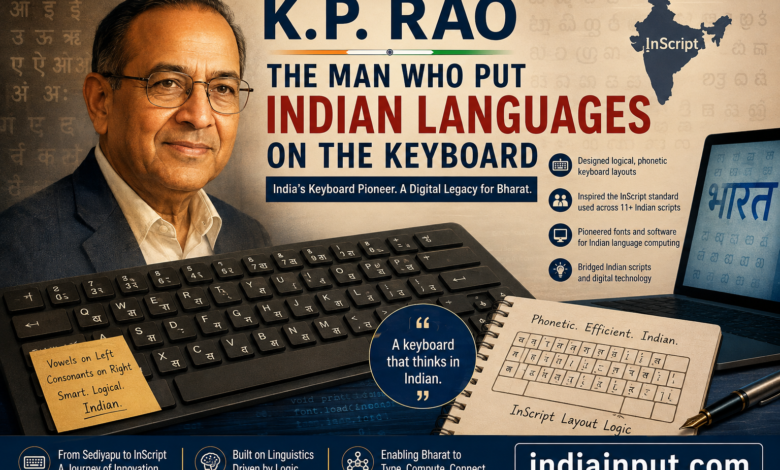
India’s Keyboard Pioneer: The K.P. Rao Story. When computers first began entering Indian workplaces, one major challenge stood in the way of truly Indian-language computing: how could people type Indian scripts efficiently on a standard keyboard? One of the pioneers who took on this challenge was K. P. Rao, a computer and language-technology innovator associated with the development of early Indian-language computing systems.
Rao’s work became particularly important because he approached keyboard design scientifically, focusing on the phonetic structure of Indian languages and the practical needs of touch-typing.
By_ https://indiainput.com Desk
The Sediyapu Keyboard Innovation
During his work with Monotype in the 1980s, K. P. Rao developed the Sediyapu keyboard layout, initially for Kannada. Rather than simply arranging characters randomly, he sought a logical system that could make typing faster and more intuitive.
The fundamental idea was to organize characters according to their linguistic relationships. Indian scripts have a highly structured relationship between vowels, consonants and vowel signs, and Rao’s approach attempted to reflect that structure on the keyboard.
This was an important step at a time when Indian-language computing was still in its early stages.
Ye प्रोफेसर राव हैं कंप्यूटर पर जो हिंदी फ़ॉन्ट हैं वो इनकी देन है… pic.twitter.com/1ldwZup8k4
— Satire Anuj (@AnujBajpai_) August 25, 2026
From Regional Innovation to InScript
The significance of Rao’s work went beyond Kannada. His keyboard-design principles contributed to the thinking that eventually influenced the development of InScript (Indian Script), the standardized keyboard layout created for Indian scripts.
InScript provided a common keyboard philosophy across several Indian writing systems, including Devanagari, Bengali, Gujarati, Kannada, Malayalam, Punjabi, Tamil and Telugu.
Its major strength was consistency: once users learned the underlying keyboard arrangement, they could adapt that knowledge to different Indian scripts.
The Logic Behind the Keyboard
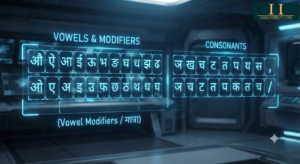
The InScript philosophy reflects the systematic nature of Indian languages. Vowels and vowel signs are arranged in a structured relationship, while consonants are grouped according to their phonetic categories.
The arrangement also considers the traditional classification of consonants—such as velar, palatal, retroflex, dental and labial sounds. This gives the keyboard a linguistic logic rather than making it merely a collection of symbols.
That design philosophy helped transform Indian-language typing from a technical obstacle into a practical computing activity.
More Than a Keyboard
K. P. Rao’s contribution was not limited to keyboard design. He was also involved in developing fonts and software tools for Indian-language computing, helping regional languages function in an era before Unicode became the universal standard.
His generation of technologists had to solve difficult problems involving character encoding, fonts, printing and digital text representation.
A Lasting Digital Legacy
Today, Indian-language users can type on computers and smartphones with comparatively little thought about the technological foundations that made it possible.
K. P. Rao’s work represents an important chapter in that journey. By combining linguistics, keyboard ergonomics and computing, he helped demonstrate that Indian scripts could have systematic, efficient digital interfaces.
The story of InScript is therefore more than the story of a keyboard. It is part of India’s larger transition from traditional scripts to the digital age—and K. P. Rao remains an important name in that transformation.
SOURCE :
http://www.bis.gov.in/other/keyboards
FEEDBACK : contact@indiainput.com
CATCHUP FOR MORE ON : https://indiainput.com