
Official or Scam? Stop the Ring Of Harassment
Why forcing caller ID apps to whitelist spam is a losing game for users.

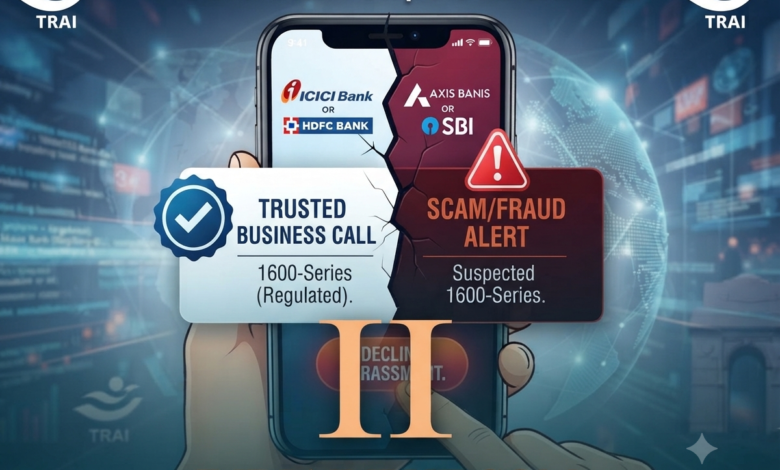
Official or Scam? Stop the Ring of Harassment. The digital landscape in India is currently embroiled in a high-stakes standoff. On one side stands the Telecom Regulatory Authority of India (TRAI), pushing to strip caller identification apps like Truecaller of their power to label 140-series and 1600-series numbers as “spam.” On the other side are the millions of mobile users who view these very labels as their only defense against a relentless barrage of telemarketing harassment.

The central question is simple: Is the government prioritizing the convenience of corporations over the digital sovereignty of the individual?
By_ Dr. Namrata Mishra Tiwari, Chief Editor https://indiainput.com
The “Official” illusion?
TRAI’s argument hinges on the premise that 140-series (telemarketing) and 1600-series (banking/service) numbers are government-sanctioned, official business channels.
The regulator contends that because these numbers are legitimate, they should not be flagged as spam, as this leads to “false positives”—where critical banking or service calls are blocked by user-installed apps.
However, this ignores a glaring reality: the intent behind the call, not just the technical classification of the number, is what defines spam for the average citizen.
Whether a call comes from a verified business line or an unofficial private number, if the recipient did not solicit the call, it is, by definition, an intrusion.
A Digital Plague
For the average Indian phone user, the phone has become a battleground. We are subjected to a constant assault of unsolicited loan offers, credit card pitches, and dubious property sales calls. These are not merely “annoying”—they are high-risk vectors for financial fraud.
When a caller ID app marks a number as “Spam/Scam,” it provides a vital split-second warning that empowers the user to hit ‘decline.’
If TRAI succeeds in forcing apps to whitelist these series, it effectively blinds the user. It forces us to answer the phone to determine if it is a legitimate transaction alert or a sophisticated phishing attempt. This is not regulation; it is an infringement on consumer safety.
The Missing Legislative Hammer
The apathy of the current system is staggering. The debate focuses entirely on the “tech” side—whether apps should be regulated—while ignoring the root cause: the pestering callers themselves.
We don’t need a debate on labels; we need a “Do Not Call” law that actually works. If a user says “no,” that should be the end of it. Any further solicitation should result in heavy, immediate penalties for the calling entity.
Until authorities focus on holding the callers accountable—by criminalizing repeat solicitation—the conflict between regulators and tech platforms will remain a mere distraction.
Our phones should be a tool for connection, not a portal for harassment. The right to silence is a fundamental digital right.
SOURCE :
FEEDBACK : contact@indiainput.com
CATCHUP FOR MORE ON : https://indiainput.com
Galaxy Z Flip8: Inside Samsung’s High-Stakes Foldable Gamble