
Fact Check: Is This Really NASA’s Latest Mars Footage?
A closer look at how authentic NASA imagery can be repackaged into sensational social media content.

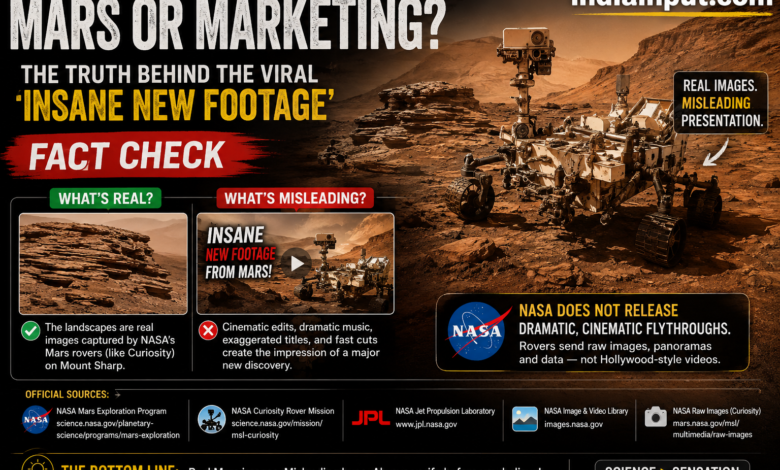
Fact Check: Is This Really NASA’s Latest Mars Footage? A viral YouTube Short claiming to show “insane new footage” from Mars has reignited discussions about how space content is presented on social media. The clip, shared by the channel Space and Science Lovers, appears visually stunning, featuring rocky Martian landscapes, dramatic background music, and cinematic editing. But does it actually reveal anything new?
According to AI-assisted fact-checking and publicly available information about NASA’s Mars missions, the answer is more nuanced than the video’s title suggests.

By_ Dr. Namrata Mishra Tiwari, Editor http://indiainput.com
The Facts Behind the Footage
The landscapes visible in the video closely resemble genuine images captured by NASA’s Mars rovers, particularly Curiosity, which has spent years exploring the slopes of Mount Sharp inside Gale Crater. The rover routinely photographs layered rock formations, dusty plains, and wind-eroded terrain to help scientists understand Mars’ geological history.
However, NASA generally releases these images as raw photographs, panoramic mosaics, or engineering frames. The agency does not typically publish dramatic, cinematic fly-through videos resembling drone footage across the Martian surface.
Where the Claim Becomes Misleading
The concern is not that the images are fake—they are largely based on authentic Mars imagery—but rather how they are presented. Fast-paced editing, suspenseful music, exaggerated captions, and phrases like “insane new footage” can give viewers the false impression that NASA has made a groundbreaking discovery or released exclusive new video.
In reality, the clip repackages existing scientific imagery into a sensationalized social media format. There is no evidence that NASA recently released a cinematic walkthrough or announced a major discovery matching the video’s implication.
The Bigger Debate
This highlights a growing challenge in science communication. Creative editing can attract millions of viewers and spark interest in space exploration. Yet when entertainment overshadows context, audiences may struggle to distinguish between genuine scientific updates and content designed primarily for clicks.
The viral Mars Short serves as a reminder that compelling visuals should be accompanied by accurate explanations. Viewers should always verify extraordinary claims through official sources before accepting them as scientific breakthroughs.
Verdict: Partially Misleading.
The landscapes originate from genuine NASA Mars rover imagery, but the dramatic editing and exaggerated framing create a misleading impression of a new, cinematic Mars discovery that NASA has not announced.
SOURCE :
http://mars.nasa.gov/msl/multimedia/raw-images
https://youtube.com/shorts/TvPbFIIzl8k?si=407zyxTIQLM-5SVU
FEEDBACK : Contact@indiainput.com
CATCHUP FOR MORE ON : http://indiainput.com
An Invitation That Speaks Without Words In Every Brushstroke
From Vada Pav to Golgappa:India’s Street Food Wins the World