Forget Smartboards. Meet the AI Blackboard.
How a viral AI blackboard is making math visual, interactive and surprisingly fun.

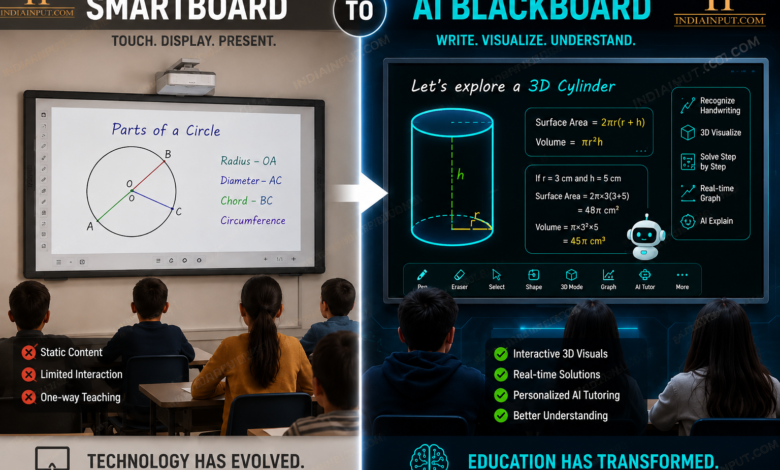
Forget Smartboards. Meet the AI Blackboard. Artificial intelligence has spent the past few years writing emails, generating essays, creating images and, critics argue, making people think less. But one innovation unveiled at the 2026 World Artificial Intelligence Conference is changing that conversation.
An AI-powered blackboard is trending across X, and for good reason.
By _ Dr, Namrata Mishra Tiwari, Editor http://indiainput.com
Not Another AI Gimmick
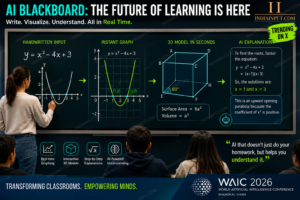
In viral demonstrations, a teacher writes a mathematical equation on the board. Within seconds, the system recognizes the handwriting, plots the graph, converts hand-drawn shapes into interactive 3D models, measures angles, calculates areas and volumes, and even explains the solution step by step. It doesn’t just display information—it helps students understand it.
For many watching online, this feels like AI finally doing what it was meant to do: expanding human understanding instead of replacing it.
2026世界人工智能大会,某科技公司展示的跨时代教具–AI黑板 pic.twitter.com/vjnXoOzlbL
— iPaul (@iPaulCanada) July 22, 2026
Math’s Real Enemy Was Never Numbers
Ask students why they dislike mathematics and most won’t say it’s because of the calculations.
The real challenge has always been imagination.
Teachers often ask students to picture three-dimensional objects from flat textbook diagrams or understand graphs by looking at static lines on paper. Many memorize formulas without ever seeing what those equations actually represent.
The gap between theory and visualization has frustrated generations of learners.
The AI blackboard attempts to bridge that gap.
A rough sketch of a cube instantly becomes a rotating 3D object. A handwritten function transforms into a live graph. Geometry becomes interactive instead of imaginary. Mathematics shifts from being something students memorize to something they can explore.
When AI Becomes a Teacher’s Best Assistant
Unlike many AI tools that complete assignments for students, this technology encourages participation rather than shortcuts.
Teachers remain at the center of the classroom, while AI provides instant visual demonstrations that would otherwise require multiple software applications and expensive digital equipment.
Instead of replacing educators, it amplifies their ability to explain difficult concepts.
That distinction matters.
Education experts have long argued that technology should support teaching—not substitute it. The AI blackboard appears to embrace exactly that philosophy.
A Classroom Revolution Beyond Mathematics
Its potential stretches well beyond algebra and geometry.
Physics lessons could simulate motion, gravity and momentum in real time. Chemistry teachers could display molecular structures that students can rotate and inspect. Engineering and architecture students could manipulate designs instantly without specialized laboratories.
The classroom itself could become an interactive workspace where ideas evolve before students’ eyes.
Learning would become less about copying notes and more about discovering concepts.
The Reality Check
As exciting as the technology appears, widespread adoption won’t be immediate.
Schools will need significant investment in smart classroom infrastructure, teacher training, software support and maintenance. Many public schools—particularly in developing nations—may find such systems financially out of reach for years.
The technology is impressive, but accessibility will determine whether it transforms education or remains confined to well-funded institutions.
The Bigger Lesson
The excitement surrounding the AI blackboard reveals something deeper than fascination with a new gadget.
Students aren’t asking artificial intelligence to solve mathematics for them.
They’re asking it to help them understand mathematics.
That is a crucial difference.
If this technology reaches classrooms around the world, future generations may spend less time memorizing formulas and more time visualizing, experimenting and asking “why” instead of simply “how.”
Perhaps the AI blackboard’s greatest achievement isn’t that it makes math easier.
It’s that it makes learning exciting again—and in an age overflowing with AI tools designed to do our thinking for us, that may be the smartest innovation of all.
SOURCE :
http://waica2026.worldaic.com.cn
FEEDBACK: Contact@indiainput.com
CATCHUP FOR MORE ON : http://indiainput.com