
Hooked by Design: Is Your Child’s Brain the Product?
A Viral Video Exposes the Psychology Behind Infinite Reels, Snapchat Streaks, Beauty Filters and Endless Notifications—and Why Protecting Children Online Must Go Beyond Parental Screen-Time Rules.

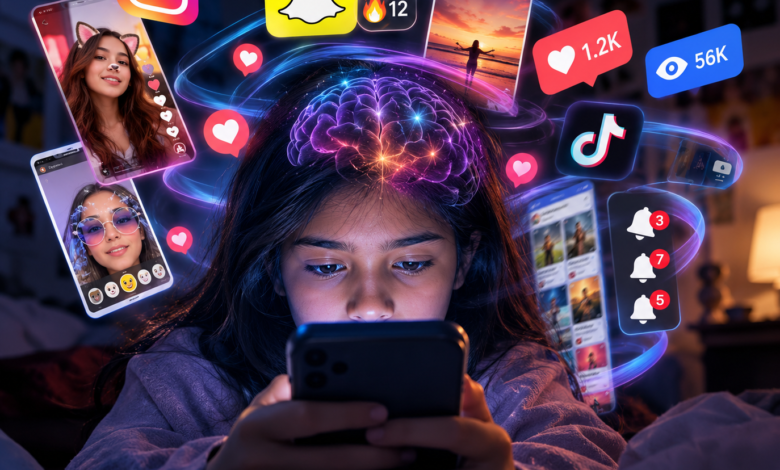
A viral video on X about social media design has highlighted a crucial question: are children simply choosing to spend hours online, or are platforms making it increasingly difficult for them to log off?
The video’s central message deserves serious attention. Behind the colourful screens and entertaining content lies an architecture of digital engagement engineered by skilled designers, developers and product teams.

By_ Dr. Namrata Mishra Tiwari, Chief Editor https://indiainput.com
The First Scroll Has No Finish Line
Remember when websites had pages that ended? Today, infinite scrolling and autoplay eliminate natural stopping points. One Reel leads to another, and another video begins before users decide whether they actually want to watch it.
A 2026 European Commission investigation preliminarily found TikTok’s design in breach of the Digital Services Act, citing features including infinite scroll, autoplay, notifications and personalised recommendations.
The concern is straightforward: when entertainment never ends, children must supply the stopping mechanism themselves.
Hats off to the person who made this. He’s hit the nail on Social Media’s head and analysed the monster top to toe. https://t.co/a93AlZ3N4d
— Aviator Anil Chopra (@Chopsyturvey) October 26, 2026
Streaks Turn Friendship Into a Daily Obligation
Snapchat streaks can transform an ordinary interaction into a numerical target. Missing a day may mean losing a streak built over weeks or months.
What begins as fun can become an obligation. Children may send messages not because they have something meaningful to say, but because they fear disappointing a friend or losing their digital achievement.
The result? Social connection risks becoming a daily attendance register.
Filters, Likes and the Popularity Scoreboard
Beauty filters and selfie effects offer instant visual transformations. Likes, views and comments then become measures against which young users compare themselves with peers.
Was my picture good enough? Why did their post receive more likes? Why is my video getting fewer views?
These questions can turn self-expression into a contest for approval. Research reviews have identified social rewards, comparison and engagement-focused features as potential contributors to problematic social media use among young people.
The 24-Hour Status and Notification Trap
Temporary statuses create curiosity and urgency: what did friends post, who viewed my update, and what might I miss?
Meanwhile, notifications repeatedly pull attention back towards the screen. A single alert can interrupt homework, family conversations or sleep, prompting users to check content they never intended to open.
Each interruption may seem insignificant. Together, they can fragment attention and make constant checking a habit.
Who Is Responsible for the Digital Trap?
The issue is not that every social media feature is inherently harmful, nor that every frequent user is clinically addicted. The concern is the combination of design choices that can encourage compulsive use, particularly among children whose self-regulation skills are still developing.
Parents can establish screen-free routines, but responsibility cannot rest on families alone. Platforms should offer meaningful stopping points, safer default settings, fewer unnecessary notifications and stronger protections for young users.
Regulators must also scrutinise recommendation systems and engagement-maximising design.
The final question is bigger than screen time: if technology companies can engineer experiences to capture attention, why shouldn’t they also be required to design experiences that respect it?
Children deserve technology that serves their growth—not systems that turn every spare moment into another opportunity to scroll.
SOURCE :
http://pmc.ncbi.nlm.nih.gov/articles/
http://digital-strategy.ec.europa.eu/
http://publications.aap.org/pediatrics/
FEEDBACK : contact@indiainput.com
CATCHUP FOR MORE ON : https://indiainput.com
SIM Binding Rules 2027: India’s New Weapon Against Cyber Fraud
पद्मश्री विंध्यवासिनी देवी: बिहार की लोकसंस्कृति की अमर आवाज़