
Faith Is Not a Licence to Pollute!
India's Civic Sense Test: When the Celebrations End, Who Takes Responsibility for Our Ghats?

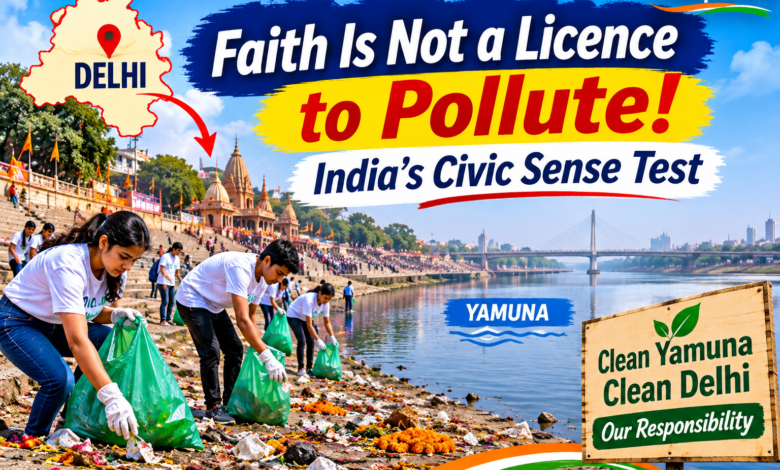
Festivals bring people together in faith, devotion and celebration. But what happens when the celebrations end? The condition of our public spaces often reveals an uncomfortable gap between religious devotion and civic responsibility.
On November 19, 2026, Delhi witnessed an encouraging example of collective action as Chief Minister Rekha Gupta joined actors Jackie Shroff and Esha Gupta, along with singers Bismil and Stebin Ben, in a cleanliness drive at the Munak Canal ghats in Shalimar Bagh.
Organised by Modern Public School and Bhamla Foundation with support from the Delhi government, the initiative brought together children, volunteers and citizens under the theme ‘Our Delhi, Our Responsibility’. The drive addressed waste left behind after Chhath Puja celebrations across 1,400 ghats, including an 11-kilometre stretch of the canal.
By _ Dr. Namrata Mishra Tiwari, Editor https://indiainput.com
Thank you, Delhi! Aastha Bhi, Swachhta Bhi! 🙏 A few days ago, we came together to celebrate Chhath. Today, we came together to clean the same ghats. So heartwarming to see our children, volunteers and citizens lead the way! #ViksitDelhi https://t.co/lKHpK7Oa6J
— Rekha Gupta (@gupta_rekha) November 19, 2026
Government Action Is Necessary, But Civic Sense Cannot Be Outsourced
The initiative deserves appreciation. However, it also raises a fundamental question: Why should citizens leave behind waste that requires a separate campaign to remove?
The government has a responsibility to provide sanitation infrastructure, adequate waste collection, disposal facilities, monitoring and enforcement. But citizens have an equally important responsibility to use these facilities and leave public spaces clean.
Faith and cleanliness should never be opposing ideas. If devotees can gather in thousands to offer prayers at river
banks, they can also ensure that flowers, plastic, food containers and other waste do not become somebody else’s burden.
Comparing India With Foreign Countries? Start With Civic Responsibility.
People often compare India’s public spaces with those of developed countries. But cleaner surroundings require more than better municipal systems. They also depend on everyday public behaviour.
We cannot demand international standards while treating public spaces as somebody else’s responsibility.
Make Cleanliness a Festival Rule, Not a Post-Festival Event
Delhi’s initiative should become a model for every state. Governments, municipal bodies, religious committees and event organisers must establish waste-management arrangements before celebrations begin, maintain them during events and ensure complete clean-up afterwards.
The real success of a festival should not end with the final prayer. It should also be measured by the condition in which we leave our rivers and ghats.
Our faith deserves respect. Our rivers deserve protection. And our cities deserve responsible citizens.
SOURCE :
FEEDBACK : contact@indiainput.com
CATCHUP FOR MORE ON : https://indiainput.com
Tractor Seva: Strengthening India’s Agri-Mechanization Ecosystem
Konkan’s Blue Revolution: Three Beaches, Maharashtra’s Global Pride!