
The Abacus Boom: Brain Booster or Education Bubble?
Are Abacus classes genuinely sharpening young minds, or are parents buying into another competitive learning trend?

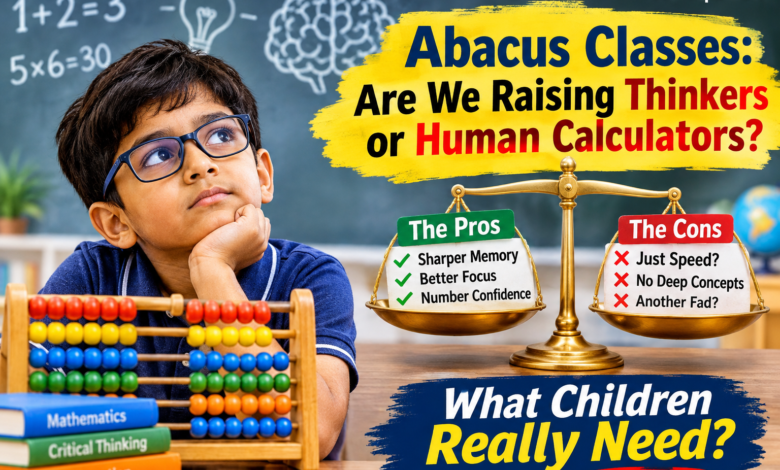
Walk into an Indian neighbourhood today and chances are you will find an Abacus coaching centre promising faster calculations, sharper memory and improved concentration. Parents are enrolling children at increasingly younger ages, but a question gaining attention on X deserves consideration: Is mental arithmetic still an essential life skill in an age when calculators and smartphones are everywhere?

BY _ https://indiainput.com Desk
The Case FOR Abacus: More Than Just Numbers
Abacus learning is not necessarily about producing human calculators. Its supporters argue that regular practice can strengthen numerical familiarity, concentration, visualisation, working memory and confidence with numbers.
Unlike simply pressing buttons on a calculator, children mentally visualise an imaginary abacus and manipulate numbers. This can make arithmetic engaging and encourage familiarity with numerical patterns.
For younger learners, it can also offer structured practice, a sense of achievement and an enjoyable introduction to mathematics. These benefits, however, depend on teaching quality and should not be confused with guaranteed improvements in overall intelligence.
The Case AGAINST: Are We Training Speed Instead of Thinking?
Critics argue that rapid arithmetic is not the ultimate objective of mathematics. Algebra, geometry, calculus and real-world problem-solving demand conceptual understanding, logical reasoning and analytical thinking.
A child who can calculate quickly may still struggle to understand why a mathematical formula works.
With digital calculators readily available, the practical advantage of extraordinary calculation speed is also debatable. More importantly, an education system obsessed with timed competitions risks rewarding performance over curiosity.
The Bigger Question: Competition or Collaboration?
Perhaps the real concern is not Abacus itself, but the growing tendency to turn every childhood activity into a competition.
Children also need collaborative projects, experiments, puzzles, creative assignments, communication skills and opportunities to solve problems together.
Abacus can be a useful supplementary learning activity, but it should never become a substitute for conceptual mathematics or a measure of a child’s intelligence.
The Verdict
Abacus is neither a miracle formula nor necessarily an educational fad. It is a tool. Its value depends on how it is used.
India needs children who can calculate, question, collaborate and innovate — not merely outperform a stopwatch.
The future belongs to thinkers, not just faster counters.
SOURCE :
FEEDBACK : contact@indiainput.com
CATCHUPN FOR MORE ON : https://indiainput.com
Tractor Seva: Strengthening India’s Agri-Mechanization Ecosystem
Konkan’s Blue Revolution: Three Beaches, Maharashtra’s Global Pride!