
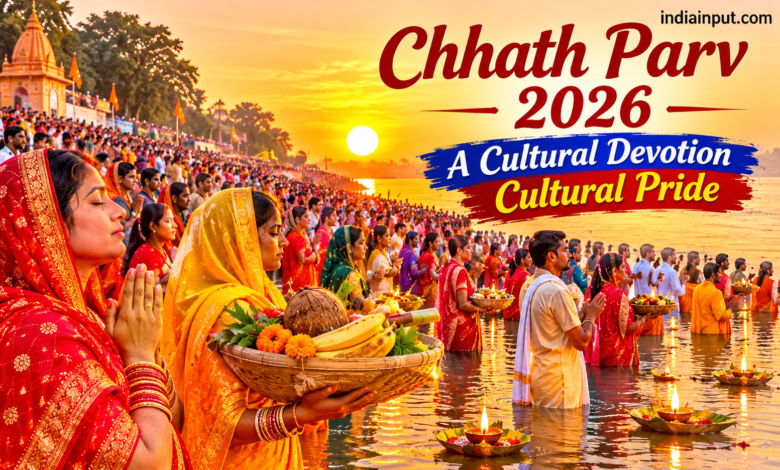
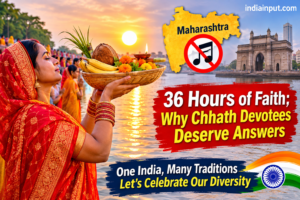
Chhath Puja is not merely a festival on the calendar. For millions of devotees, particularly those from Bihar, Jharkhand and eastern Uttar Pradesh, it is an expression of deep faith, discipline, gratitude and devotion to the Sun God.
The observance involves rigorous fasting, prayers and offerings to the setting and rising Sun. The traditional 36-hour period of fasting is an important part of the devotion for many worshippers.
Yet, as Mumbai prepares for Chhath Puja 2026, the festival has become the centre of a cultural debate.
By _https://indiainput.com Desk
The controversy began after Bhojpuri devotional songs were played at several Mumbai railway stations ahead of the festival. Objections from political groups followed, and the songs were reportedly stopped at some stations.
This raises an important question: Why should the celebration of one community’s religious and cultural traditions become a source of division?
Maharashtra’s Identity and India’s Diversity
Maharashtra has a rich cultural identity, with festivals such as Ganeshotsav, Gudi Padwa, Navratri and numerous regional celebrations forming an integral part of its heritage.
Respecting Marathi culture, however, need not mean questioning the cultural expression of communities that have made Maharashtra their home.
Mumbai, in particular, has grown through contributions from people belonging to different states, languages and traditions. Bihari families and other migrant communities are also part of this social and economic fabric.
Celebrating Chhath Puja does not diminish Maharashtra’s traditions. Similarly, celebrating Ganeshotsav or Gudi Padwa should not require anyone to set aside their own cultural identity.
A ban on Chhath Puja celebrations and devotional songs? The Maharashtra government must clarify its decision. People’s faith and cultural traditions deserve respect. Devotees deserve answers, not restrictions! 🙏 #Chathpuja #Maharastra #Rajthakry https://t.co/mtR46Mb4Th
— Ritika (@Im_Ritikaa) November 13, 2026
Religious Freedom Must Coexist With Civic Responsibility
India’s Constitution guarantees freedom of conscience and the right to practise religion under Article 25, subject to public order, morality and health.
This means celebrations must follow applicable permissions and public-safety regulations. But those regulations should be applied fairly and transparently, without turning cultural identity into a point of confrontation.
If there are concerns about public announcements, noise levels, crowd management or venue permissions, authorities should explain them clearly and provide reasonable arrangements wherever possible.
The Bombay High Court’s November 9 order also referred to the constitutional limitations and permission requirements applicable to public celebrations.
One India, Many Traditions
A country as diverse as India cannot build unity by asking communities to leave their traditions behind.
Whether it is the sound of Ganpati aarti in Maharashtra, Durga Puja celebrations in Bengal, Onam in Kerala or Chhath devotional songs in Bihar, every tradition contributes to India’s cultural richness.
The Maharashtra government and concerned authorities should clarify the applicable restrictions and explain how devotees can observe the festival without unnecessary obstacles.
A devotee’s faith should not become a political controversy. Cultural pride should create space for other cultures, not close it.
Chhath Puja is a celebration of faith, nature, gratitude and devotion. Its devotees deserve dignity, clarity and respect!!!
India’s strength lies in its diversity. Let us celebrate that diversity rather than turn it into a dividing line.
SOURCE :
https://bombayhighcourt.nic.in
https://cr.indianrailways.gov.in
https://www.maharashtra.gov.in
FEEDBACK : contact@indiainput.com
CATCHUP FOR MORE ON : https://indiainput.com
Konkan’s Blue Revolution: Three Beaches, Maharashtra’s Global Pride!
The Divine Alms: When Mahadev Seeks Food from Maa Annapoorna