
Food First, Profits Later: Mundhe’s Healthy Schools Mission
Restricting junk food around schools is more than an administrative order—it's a blueprint for a healthier future.

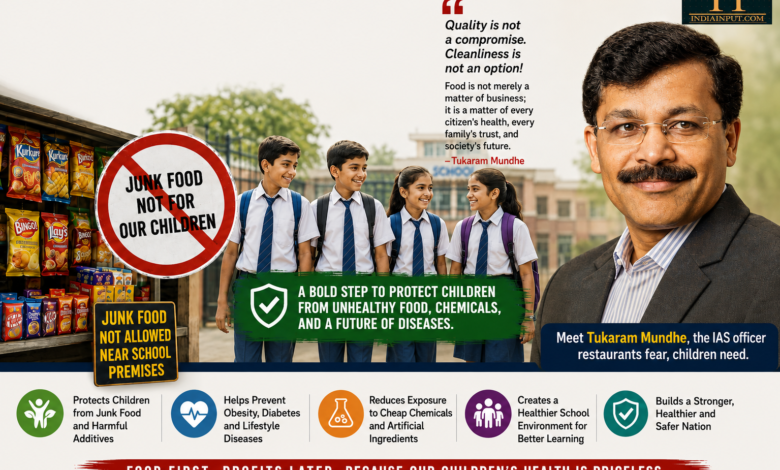
Food First, Profits Later: Mundhe’s Healthy Schools Mission. “Quality is not a compromise. Cleanliness is not an option! Food is not merely a matter of business; it is a matter of every citizen’s health, every family’s trust, and society’s future.” These words by IAS officer Tukaram Mundhe capture the spirit of his latest initiative to restrict the sale of chips, chocolates, and other unhealthy food items near school premises.

By_http://indiainput.com Desk
The move is more than an administrative directive—it is a public health intervention. In an era where processed foods dominate children’s diets and food adulteration continues to plague the country, Mundhe’s decision places the well-being of students above commercial interests.
A Growing Food Safety Crisis
India has witnessed an increasing number of food adulteration cases in recent years. From synthetic milk and adulterated spices to counterfeit edible oils, artificial colours, and chemical-laden sweets, unsafe food products have found their way into homes across the country.
While regulatory agencies continue to crack down on offenders, the challenge remains enormous. Unscrupulous manufacturers often use cheaper substitutes, excessive preservatives, artificial flavours, colours, and unhealthy additives to maximize profits. These shortcuts may reduce production costs, but they come at the expense of public health.
गुणवत्ता ही तडजोड नाही. स्वच्छता हा पर्याय नाही!
अन्न हा केवळ व्यापाराचा विषय नाही; तो प्रत्येक नागरिकाच्या आरोग्याचा, प्रत्येक कुटुंबाच्या विश्वासाचा आणि समाजाच्या भविष्याचा विषय आहे.#FoodSafety #PublicHealth #GoodGovernance #Accountability #TukaramMundhe pic.twitter.com/wOR1OycZQB
— Tukaram Mundhe (@Tukaram_IndIAS) July 27, 2026
Children Are the Most Vulnerable
School-going children are among the biggest consumers of packaged snacks. Vendors stationed outside schools often sell chips, chocolates, sugary beverages, candies, and processed snacks that are high in salt, sugar, unhealthy fats, and additives while offering very little nutritional value.
Daily exposure to these foods shapes eating habits at an early age. Regular consumption increases the risk of obesity, diabetes, hypertension, dental problems, and other lifestyle diseases that are now appearing at younger ages than ever before.
Healthy eating begins with creating healthy surroundings, and school zones should encourage nutritious choices rather than unhealthy temptations.
A Preventive, Not Punitive, Measure
Tukaram Mundhe’s decision should not be viewed as a restriction on business but as a preventive measure designed to protect children. Schools exist to nurture young minds and healthy bodies, and the environment surrounding them should reflect that objective.
By limiting access to junk food near educational institutions, the administration is encouraging healthier habits without preventing vendors from operating elsewhere or promoting more nutritious alternatives.
All brands fear this man.
Corrupt bureaucrats fear this man.He was transferred 24 times to break his courage, but he is still wild as a tiger.
This man has the full potential to change the food safety system of India, which has been in a coma for many decades.
Make IAS… pic.twitter.com/5M5YK2dKOi
— Nalini Unagar (@NalinisKitchen) August 1, 2026
More Than Just Junk Food
This initiative also sends a wider message about India’s ongoing battle against food adulteration and poor-quality food products. Cheap chemicals, excessive artificial colouring, low-grade ingredients, and highly processed foods have increasingly replaced fresh, wholesome options in many diets.
Parents today are becoming more aware of ingredient labels and food quality, yet children remain easy targets for aggressive marketing and attractive packaging. Administrative interventions like this help bridge the gap between awareness and action.
A Model Worth Replicating
If implemented effectively and adopted by other districts and states, this initiative could become a model for promoting healthier school environments nationwide. Combined with stronger food safety enforcement, nutrition education, and greater availability of healthy snacks, such measures can significantly improve children’s health outcomes.
Protecting India’s Future Begins with Its Children
Tukaram Mundhe has long been known for taking firm administrative decisions in the public interest. His stand against the sale of unhealthy food near schools continues that legacy by focusing on one of the nation’s most valuable assets—its children.
At a time when processed foods, adulteration, and unhealthy eating habits are becoming increasingly common, his initiative serves as a timely reminder that governance is not just about infrastructure or administration. It is also about safeguarding public health.
Protecting children from unhealthy food environments today is an investment in a healthier India tomorrow.
SOURCE :
https://fda.maharashtra.gov.in/
FEEDBACK : Contact@indiainput.com
CATCHUP FOR MORE ON : http://indiainput.com