
From Chalkboards to Chatbots: CBSE’s Digital Learning Leap. In a landmark move aligned with India’s evolving education landscape, the Central Board of Secondary Education (CBSE) has announced “Computational Thinking (CT) and Understanding Artificial Intelligence (AI)” as the official training theme for the 2026–27 academic session.
This initiative reflects the broader vision of the National Education Policy 2020 (NEP 2020) and the National Curriculum Framework for School Education 2023 (NCFSE 2023), both of which emphasize future-ready, skill-based learning.
By_ https://indiainput.com Desk
From Classrooms to Code: A New Curriculum Era
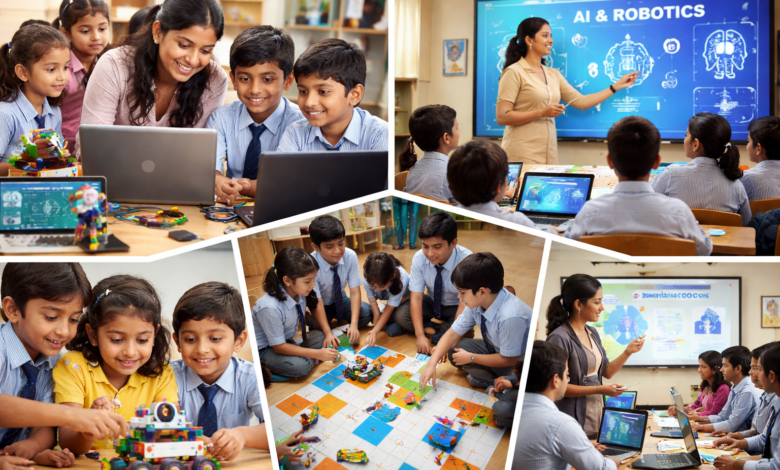
Starting from the 2026–27 session, CBSE has introduced a dedicated curriculum on Computational Thinking and Artificial Intelligence for students in Classes 3 to 8. This marks a significant departure from traditional rote-based education, embedding digital literacy and analytical thinking at an early stage.
The curriculum focuses on key competencies such as logical reasoning, problem-solving, pattern recognition, and data interpretation. Importantly, it also stresses the ethical use of AI—ensuring students not only learn technology but understand its societal impact.
Rather than increasing screen dependency, the approach blends hands-on activities, projects, and interdisciplinary learning, integrating AI concepts into everyday subjects like mathematics and science.
http://
The Central Board of Secondary Education has announced the Training Theme for the session 2026–27 as “Computational Thinking (CT) and Understanding Artificial Intelligence (AI)” in line with NEP 2020 and NCFSE 2023.
A curriculum on “Computational Thinking and Artificial… pic.twitter.com/JZ350hoiFS
— CBSE HQ (@cbseindia29) April 10, 2026
Training the Teachers, Transforming the System
Recognizing that effective implementation begins with educators, CBSE has structured an extensive teacher training program around this theme. Schools are encouraged to nominate teachers for workshops, participate in expert-led sessions, and organize school-level and district-level activities.
A key component of this initiative is District-Level Deliberations (DLDs), where schools collaborate, share innovative practices, and present case studies. Selected ideas may even receive national recognition, fostering a culture of innovation and peer learning.
Additionally, CBSE’s Centres of Excellence will conduct regional orientation programs, ensuring consistent training quality across the country.
Building Future-Ready Learners
This initiative is part of a broader national push to make AI a foundational skill—similar to literacy and numeracy. By introducing these concepts from Class 3 onwards, CBSE aims to prepare students for an increasingly technology-driven world.
The phased rollout ensures that younger students develop computational thinking skills, while higher classes gradually move toward deeper AI concepts, data literacy, and real-world applications.
The Road Ahead
CBSE’s move signals a paradigm shift in Indian education—from memorization to meaningful learning. By combining CT and AI with ethical awareness and practical application, the board is not just teaching students how to use technology, but how to think with it.
As schools gear up to implement this ambitious reform, the success of this initiative will depend on collaboration between educators, institutions, and policymakers. If executed effectively, it could redefine how India’s next generation learns, innovates, and leads in the digital age.
SOURCE :
FEEDBACK : contact@indiainput.com
CATCHUP FOR MORE ON : https://indiainput.com
No Silver Medals in Security: Doval’s “New Awakening” Call
Opportunity Knocked. Hinge Broke the Door #IPL Season 19
Kerala’s Free Degree Revolution: Zero Fees, High Stakes
Toll Wars @Sea: Who Controls the World’s النفط Oil Lifeline?
Toll Wars @Sea: Who Controls the World’s النفط Oil Lifeline?