
Gen Z Makes a Splash: From Scrolls to Swachhata
Young citizens are turning social-media inspiration into real-world action to protect India’s rivers.

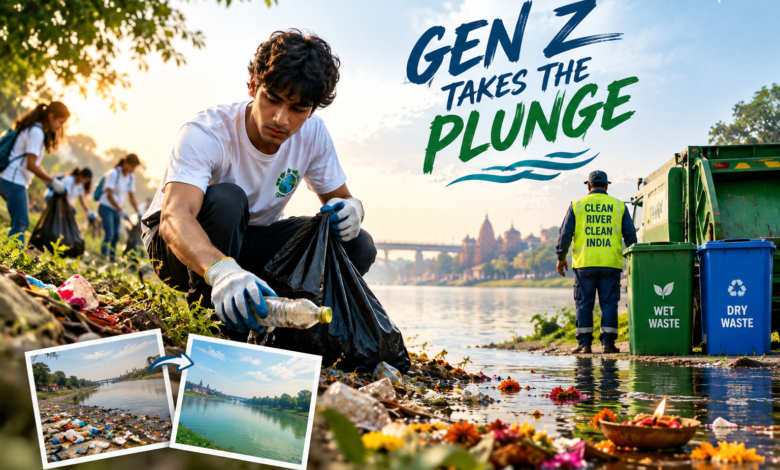
Gen Z Makes a Splash: From Scrolls to Swachhata. When Young India Refuses to Look Away. A new cleanliness movement is emerging across India — and Gen Z actively taking on the initiative. The viral efforts surrounding Madhya Pradesh’s Bittu Tabahi, who took up the cleaning of the polluted Ajnar River, have sparked a wider conversation about what citizens can do when public spaces are neglected.
His work has also drawn attention to the fact that grassroots environmental efforts are not always new; many individuals and community groups have quietly worked for years without receiving recognition.
By _ https://indiainput.com Desk
That distinction matters. The objective should not be to create another celebrity out of a cleanliness campaign, but to celebrate every citizen who turns concern into action.
Stop this nonsense!
These are man-made practices using synthetic materials! You cannot call her Bharat Mata if you pollute her! pic.twitter.com/4hw8s9iMx5— JIX5A (@JIX5A) September 7, 2026
The Plastic, Flowers and Diya Problem
One of the biggest questions is what happens after a river has been cleaned.
Plastic bags, bottles, religious offerings, flowers, cloth and discarded diyas can quickly turn a restored riverbank into another dumping ground. The answer cannot simply be to clean the river again and again.
Municipal bodies and local administrations should enforce strict no-dumping rules around rivers and water bodies, backed by visible monitoring, adequate bins, collection points and penalties where legally applicable. Religious and community organisations can also help by encouraging environmentally responsible ways of handling flowers, diyas and other offerings.
The principle should be simple: faith deserves respect, but rivers deserve protection too.
The Bittu Tabhi fever is machaoing “tabahi” (in the positive sense) as several youth are getting infected with a deep desire to clean up & reclaim their precincts
I think @narendramodi ji should immediately felicitate this Swachh Bharat Warrior and make him the Yuva Brand…
— Sameer (@BesuraTaansane) September 7, 2026
From One River to a Wider Movement
The most encouraging development is the possibility of imitation for the right reasons. Images and videos of river-cleaning efforts are encouraging other young people and community groups to take responsibility for their surroundings.
Social media can therefore become more than a platform for complaints. It can document problems, bring volunteers together and make civic neglect visible.
But citizens should not have to repeatedly rescue public infrastructure through individual effort.
Bittu tabahi inspired india but this 40-member team has quietly protected ancient heritage for two years. pic.twitter.com/FqGePpCFNY
— Saavni Srivastva 🍁 (@IntrovertSaavni) September 7, 2026
Civic Bodies Must Own the Responsibility
Gen Z activism should complement civic administration — not substitute for it.
Municipal corporations and local authorities have the infrastructure, manpower and legal responsibility to maintain public spaces. They should regularly inspect riverbanks, prevent waste accumulation, ensure timely collection and respond quickly when dumping begins.
The successful wet-and-dry waste segregation model offers an important lesson: when authorities provide the system, citizens are far more likely to participate. Separate bins, regular garbage-truck collection and public awareness can turn cleanliness from a campaign into a daily habit.
नदियों और तालाबों को साफ करने की यह क्रांति अब हर गांव तक पहुंच गई है। pic.twitter.com/tIEcgBdQkO
— छपरा जिला 🇮🇳 (@ChapraZila) September 7, 2026
From Viral Moment to Permanent Culture
The real success of the Bittu Tabahi phenomenon will not be measured by views, followers or viral posts. It will be measured by whether communities continue protecting their rivers after the cameras leave.
Gen Z has demonstrated that young citizens can start conversations, mobilise people and challenge indifference. Now civic bodies must match that energy with consistent enforcement, infrastructure and accountability.
Youth of India taking the responsibility of keeping the nation clean. 🇮🇳🔥 pic.twitter.com/L5xVSgAbjm
— FalconUpdatesHQ (@FalconUpdatesHQ) September 8, 2026
A clean river should not depend on one determined youngster.
It should be the shared achievement of citizens, municipalities, local organisations and authorities working together.
The message is simple: Don’t just clean the river — stop polluting it. Don’t wait for someone else — take responsibility. And don’t let a viral cleanliness drive become yesterday’s news.
SOURCE :
FEEDBACK : Contact@indiainput.com
CATCHUP FOR MORE ON : https://indiainput.com