
ISRO Is Not Up for Sale—India Is Opening Space
Chairman V. Narayanan draws a line between privatisation and private participation.


ISRO Is Not Up for Sale—India Is Opening Space. The Indian space programme is entering a new phase—but that does not mean ISRO is being privatised.
ISRO Chairman V. Narayanan has dismissed concerns surrounding the alleged privatisation of the Indian Space Research Organisation, making it clear that ISRO remains a government organisation.
His clarification comes amid growing attention around the expanding role of private companies and startups in India’s space sector. According to Narayanan, their increasing participation is part of a larger effort to build and expand India’s space ecosystem—not to transfer ISRO into private hands.
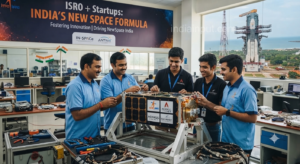
The distinction is crucial as India seeks to transform its space programme into a much larger national space economy.
By _ https://indiainput.com Desk
ISRO Remains India’s Space Backbone
For decades, ISRO has been at the heart of India’s space ambitions, developing launch vehicles, satellites and technologies that have supported communication, navigation, weather forecasting, scientific research and national missions.
That role is not disappearing.
Instead, the government’s approach is increasingly focused on allowing private industry to participate in areas where commercial innovation and investment can accelerate growth.
In simple terms: ISRO remains the government institution, while the ecosystem around it gets bigger.
𝐑𝐮𝐦𝐨𝐮𝐫 → 𝐑𝐚𝐠𝐞-𝐭𝐰𝐞𝐞𝐭 → 𝐑𝐞𝐚𝐥𝐢𝐭𝐲 𝐜𝐡𝐞𝐜𝐤 → 𝐒𝐭𝐢𝐥𝐥 𝐬𝐜𝐫𝐞𝐚𝐦𝐢𝐧𝐠!
Classic ‘Naraz Fufa’ operating system. 😂 pic.twitter.com/5ccrfmWdRL
— BJP (@BJP4India) September 7, 2026
Why Startups Matter to India’s Space Ambitions
The emergence of Indian space startups has opened a completely new chapter.
Private companies can contribute to launch vehicles, satellite manufacturing, components, space-based applications and other commercial services. Their participation can bring additional investment, entrepreneurial innovation and new technological capabilities into the sector.
This does not necessarily compete with ISRO’s core mandate.
It can complement it.
A broader ecosystem means that ISRO can concentrate on complex scientific missions, advanced technologies and national priorities while private enterprises develop commercially viable applications and services.
“43 years ago, when I joined ISRO, one launch used to happen once in 3 years. Today, 50 launches per year is going to be a reality soon.” – Dr. V. Narayanan, Chairman, ISRO
From 1 launch every 3 years to 50 a year. What a massive transformation! pic.twitter.com/ZH8taQYv2R
— Varun Kumar Rana (@VarunKrRana) September 7, 2026
From ISRO Alone to ISRO + Industry
The bigger transformation is therefore not “ISRO versus private companies.”
It is “ISRO plus private industry.”
A globally competitive space sector needs government institutions, startups, established companies, researchers and universities working alongside one another.
For India, this could mean more launches, more satellite capabilities, greater technological innovation and the creation of a larger domestic space industry.
But expansion must also come with responsible regulation, transparency and appropriate safeguards, particularly where national security and strategic technologies are involved.
India’s Space Story Is Getting Bigger
Narayanan’s statement cuts through an important misconception: private participation does not automatically mean privatisation.
ISRO continues to remain a government organisation. What is changing is the size and diversity of the ecosystem surrounding it.
India’s space journey began with a government-led institution building capabilities from the ground up. The next chapter could see that institution acting as the technological backbone of a much larger national space economy.
ISRO isn’t being sold. The ecosystem around ISRO is being expanded.
And that distinction could be central to India’s ambition of becoming a major global space power.
source :
FEEDBACK : contact@indiainput.com