
Deep Space Shock: Rare Cosmic Blast Detected
Explore the science, facts, and mystery behind one of the early universe's brightest explosions.

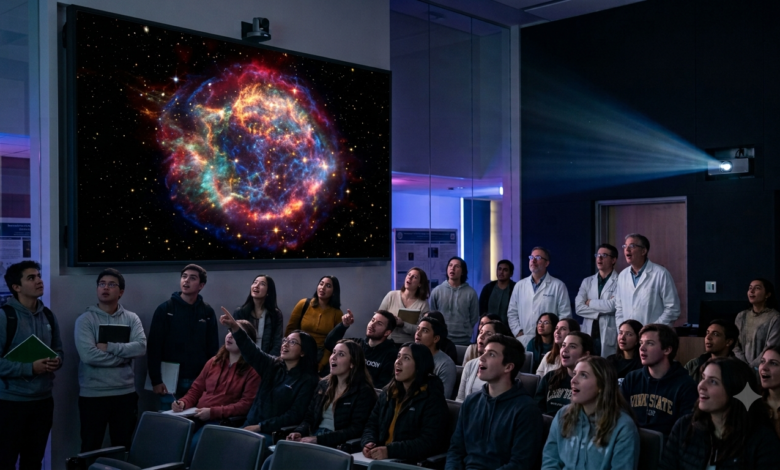
A Rare Front-Row Seat to Cosmic Power. Modern astronomy continues to prove that our universe is far more dynamic than textbook models suggest. Astronomers analyzing observations from the James Webb Space Telescope (JWST) announced the detection of a rare supernova explosion, designated AT 2026abck, caught just days after the initial stellar rupture in the early cosmos.
The discovery has sent a wave of excitement across research institutions, leaving both seasoned scientists and science students thoroughly amazed.
“Catching a massive star collapse within days of its initial rupture offers researchers a rare, unmagnified front-row seat to the early universe.”
Fact-Checking the Discovery: What Really Happened?
When celestial events make headlines, separating scientific fact from speculation is essential:
-
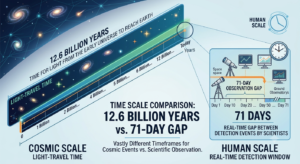
Fact Check 1 (The Light-Travel Delay): While the event was detected by space observatories just days after its light reached our instruments, the explosion itself did not occur last week. Because AT 2026abck sits at a redshift of $z \approx 5.017$, the light traveled for roughly 12.6 billion years across expanding space before reaching Earth. We are observing the universe when it was only 1.2 billion years old.
-
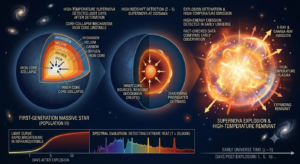
Fact Check 2 (Unusual Temperature & Brightness): Unlike standard nearby Type II supernovae—which typically cool rapidly—initial measurements revealed AT 2026abck was significantly hotter (exceeding 15,000 K) and far brighter than typical star deaths at a similar stage.
-
Fact Check 3 (No Black Hole Distortion): Spectroscopic and spatial analysis confirmed the blast occurred in a star-forming galaxy region away from the galactic center, ruling out a supermassive black hole tearing a star apart (a tidal disruption event).
Why Students and Scientists Are Captivated
For astronomers, catching a supernova within days of its onset without gravitational lensing magnification provides raw, unmagnified data on how early, metal-poor stars evolved and died. For students stepping into astrophysics, AT 2026abck serves as a vivid reminder that cosmic frontiers remain wide open, offering endless surprises for the next generation of discoverers.
SOURCE :
https://youtube.com/shorts/yS5UpFFVDe4?si=Rm7WyBzRukXDENd-
CATCHUP FOR MORE ON: https://indiainput.com