
Paper Borders, Real Scars: How 1956 Fractured South India
Mapmakers promised administrative order. They delivered seventy years of border friction.

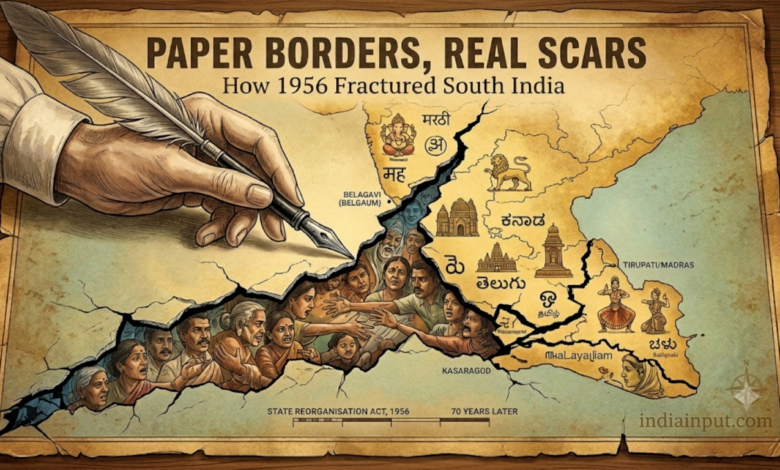
Every November 1st, official celebrations break out across Southern India. Piravi or State Foundation Days bring out parades, speeches, and public declarations of linguistic pride. But away from the capitals, along the borders, that pride turns into a much more complicated reality.
Arbitrary Boundaries and Lasting Fault Lines
When bureaucrats redrew the map of Southern India under the States Reorganisation Act of 1956, they tried to fit centuries of mixed, fluid cultures into strict linguistic boxes. The goal was administrative order. The result was a patchwork of unresolved border disputes that still flare up today.
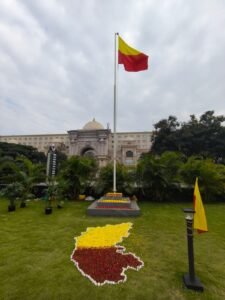
Images & Inputs by Mrs. K.P. Gunavati from Kasargod to the https://indiainput.com Desk
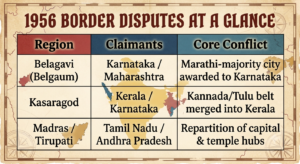
Take Belagavi (Belgaum). Placed in Karnataka despite a large Marathi-speaking population, the city has spent decades caught in a tug-of-war between two states.
Whenever elections near, political leaders dust off the old arguments, border trade grinds to a halt during bandhs, and the dispute remains parked in the Supreme Court.
Local residents are left handling the fallout of an argument framed almost seventy years ago.
High-Stakes Partitioning: From Tirupati to Kasaragod
The same story played out across the region. When the old Madras Presidency was carved up, high-stakes political maneuvering decided where key cities landed.
Tamil Nadu kept Madras (Chennai) after Telugu leaders pushed to claim it, while Andhra Pradesh secured Tirupati.
Further west, Kasaragod was folded into Kerala despite deep cultural and linguistic ties to Karnataka, leaving its Kannada- and Tulu-speaking pockets navigating a state system built around Malayalam.
The Human Cost Along the Fringes
While state capitals celebrate linguistic pride, the borderlands inherit the fallout. The people living along these artificial fringes navigate a dual-identity crisis daily:
Educational Barriers: Mother-tongue instruction and bilingual school curricula are systematically phased out.
Civic Marginalization: Mandatory state-language requirements limit access to local government jobs and public services.
Economic Strain: State-level political posturing frequently disrupts local trade and borderland commerce.
The Reality: For millions along these administrative fringes, state borders are not symbols of linguistic liberation, but daily hurdles to civic inclusion.
The 1956 reorganization assumed that language was a hard border. But language in border towns doesn’t work like that; it bleeds across roads, markets, and marriages.
As state capitals celebrate November 1st with grand speeches, the borderlands are left dealing with the mess left behind when mapmakers tried to slice through a shared culture.
SOURCE :
https://en.wikipedia.org › wiki › States_Reorganisation_…
FEEDBACK : contact@indiainput.com
CATCHUP FOR MORE ON : https://indiainput.com
Eyes in Space, Lives on Earth: How INSAT-3DS Tracked Cyclone Arnab