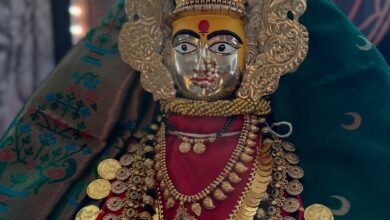
When Bappa Leaves, What Remains Within Us?
A short, but intriguing reflection that connects Ganapati Atharvashirsha with our journey as a Karyakarta..


 “When Bappa Leaves, What Remains Within Us?” A short, but intriguing reflection by Pushpahas Hadap, (A Swayamsevak, currently based in New Jersy, USA) that connects Ganapati Atharvashirsha with our journey as a Karyakarta (Swayamsevak; Volunteer; Worker) taking responsibility, sustaining karya, listening, and bringing our words and actions closer together.
As Bappa leaves after visarjan, perhaps the real question is: What stays within us? A must read, for every positively inclined doer..
When Bappa Leaves, What Remains Within Us?
 Today, on Anant Chaturdashi, as we bid farewell to Bappa, the emotions feel a little different.
There is always a certain emptiness after visarjan. For the past several days, Bappa had become part of our home, our conversations and our daily rhythm. Aarti, naivedya, Atharvashirsha, gatherings with family and friends, and then suddenly it is time to say goodbye.
“गणपति बाप्पा मोरया… पुढच्या वर्षी लवकर या!”
There is joy in that chant, but also a heaviness. Gratitude that Bappa came into our lives, and at the same time, a reluctance to let Him go.
 This year, another thought was quietly running in the background. A few days ago, I happened to listen to a Marathi conversation on Ganapati Atharvashirsha. I have heard and recited Atharvashirsha many times before. Some verses are so familiar that the words almost flow automatically. But this conversation made me hear those same words a little differently.
And today, while watching Bappa leave, some dots began to connect. We welcome Ganapati into our homes. We worship Him. We recite Atharvashirsha. And finally, we perform visarjan. But maybe an important question begins after visarjan. If the murti of Ganapati leaves our home, what from these ten days remains within us?
Atharvashirsha repeatedly addresses Ganapati as “त्वम्” You.
“त्वमेव केवलं कर्तासि।” You alone are the doer.
“त्वमेव केवलं धर्तासि।” You alone are the sustainer.
“अव वक्तारम्। अव श्रोतारम्।” Protect the speaker. Protect the listener.
“ऋतं वच्मि । सत्यं वच्मि ।” I speak what is right. I speak the truth.
“त्वं साक्षादात्मासि नित्यम्।” You are the very Self.
The verses address Ganapati as “त्वम्,” and there is no need to change that. But while reciting them, can I also allow those words to question how I live?
 That, to me, becomes a form of swa-samvaad.
When I say “त्वमेव केवलं कर्तासि,” can it remind me to take responsibility for the work in front of me? When I say “त्वमेव केवलं धर्तासि,” can it make me think about whether I have the patience to sustain what I begin?
When the prayer remembers both वक्ता and श्रोता, can I ask whether I give listening as much importance as speaking? And when I say “ऋतं वच्मि । सत्यं वच्मि,” can I look honestly at whether my words and actions are moving closer together?
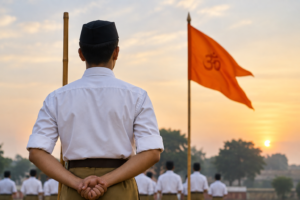
As a Sangh swayamsevak, these questions feel very familiar. The word karyakarta itself contains karta. Not in the same sense as “कर्ता” in Atharvashirsha, but in a very practical sense: karya needs people who take responsibility. Somewhere in our Sangh journey, a small change begins to happen. Initially, we participate.
Someone sends the reminder. Someone prepares the boudhik. Someone brings the dhwaj. Someone plans the utsav. Someone follows up with a family that has not been coming to shakha. Then, slowly, the question changes from “Who is taking care of this?” to “I can take care of this.” That simple shift is an important part of karyakarta nirmaan.
We see it in small moments. A swayamsevak reaches sanghasthan a few minutes early without being reminded. A shikshak notices a new family standing quietly on the side and walks over to welcome them. Someone realizes that a swayamsevak has not come for a few weeks and makes a phone call, not because the Karyavah assigned it, but because something within says, “I should check on him.”
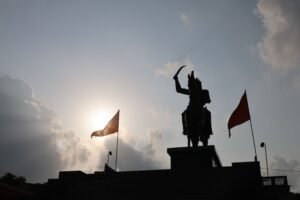
No announcement. No recognition. Just swayam-prerana.
Maybe that is one practical lesson we can take from the thought of karta: not “I am the doer,” but “I will not keep waiting for someone else to act.”
Then comes “त्वमेव केवलं धर्तासि” You are the sustainer. For a karyakarta, this brings another reflection. Starting something is often exciting. Sustaining it takes patience, consistency and tapasya.
A new shakha can begin with enthusiasm. An utsav may bring good sankhya. A seva project may attract many volunteers. A new idea may sound excellent in a baithak. But the real test comes after the initial energy settles.
Who continues sampark when no utsav is approaching? Who patiently prepares the next shikshak? Who stays connected with a family that came once and then disappeared? Who keeps shakha going through school calendars, work travel, children’s activities and the normal realities of family life in America? That ability to sustain is equally important.
In vargs and boudhiks, we often hear small incidents from Doctorji’s life. One such incident I have heard is about Doctorji returning very late from a program outside Nagpur after a difficult journey.
The next morning, he was present for the scheduled Sunday program. Whenever such an incident is narrated in a varg, nobody really needs to explain the lesson. Doctorji did not need to speak about punctuality or commitment. His presence conveyed it.
That is something we experience in Sangh even today. People may forget many things we say, but they remember how they experience Sangh through us. Our conduct often communicates more than our words.
That thought connects naturally with another prayer in Atharvashirsha: “अव वक्तारम्। अव श्रोतारम्।” Protect the speaker. Protect the listener.
We spend a good amount of effort developing vaktas. We prepare boudhiks, conduct charchas, encourage Vivaksha and help swayamsevaks express Hindu thought with clarity and confidence. All of that is valuable. But the prayer remembers the shrota along with the vakta.
Do we give enough attention to becoming good listeners? That question matters especially in sampark. Sometimes we approach a family already thinking, “Why are they not coming to shakha?” But have we first listened?
Maybe the parents are overwhelmed. Maybe the kishore does not yet feel connected. Maybe someone misunderstood something that happened at shakha. Maybe the family is going through something we know nothing about. Or maybe someone is simply waiting for a genuine, “How are you doing?”
Sampark is not only about sankhya. It begins with atmeeyata.
 We speak, but we also listen. Relationships grow when people feel that we genuinely care. That is where Shuddha Satvik Prem becomes real. It is not transactional. It does not begin by asking, “What can this person do for the karya?” It begins with a genuine human connection.
So “अव श्रोतारम्” becomes a simple reminder: listening too is part of our sadhana.
Then comes another line which feels even more personal: “ऋतं वच्मि । सत्यं वच्मि ।”
For a swayamsevak, charitra cannot remain separate from Sangh karya. Our credibility is part of the karya. If I ask others to reach shakha on time but regularly arrive late, my words carry less weight. If I speak about Hindu values but my colleagues cannot trust my word, something is missing.
If I speak with affection at shakha but behave very differently at home, our children notice that contradiction much earlier than we imagine.
Atharvashirsha makes me ask a very simple and difficult question: does my own life make Satya believable? And then comes one of the most beautiful lines: “त्वं साक्षादात्मासि नित्यम्।” You are the very Self.
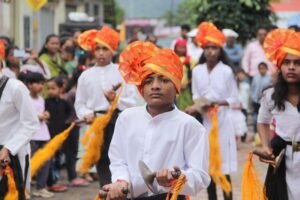
For several days during Ganeshotsav, we invoke Bappa with flowers, lamps, fragrance, music, food and devotion. We decorate the mandap, perform aarti, offer modak and gather as families and communities.
Then comes Anant Chaturdashi. The murti goes. The decorations come down. The sounds of “गणपति बाप्पा मोरया” slowly fade. But the sadhana need not end there. Something can remain. A little more responsibility. A little more patience to sustain. A better habit of listening. A stronger commitment to ऋतम् and सत्यम्.
In Sangh too, the real test of shakha often begins after Vikira. Can I carry something of shakha into my home, my workplace and my relationships? Can the discipline of Daksha become attentiveness in everyday life? Can sampark become genuine concern for another person?
Can the spirit of tyaga represented by Bhagwa Dhwaj stay with me even when nobody from shakha is watching? Then shakha is no longer simply one hour in the weekly calendar. It becomes a samskar.
And Ganeshotsav is no longer only a festival that comes and goes every year. It becomes an opportunity to work on ourselves. We do not have to change everything in one year. Maybe just one thing.
Maybe I need to take responsibility instead of waiting for someone else. Maybe I need more patience to sustain a karya. Maybe I need to listen better. Maybe I need to bring my words and actions a little closer together.
And when Ganapati returns next year, I would like to be able to look at Bappa during that first aarti and quietly say: “One thought that I recited last year, I tried to live a little more sincerely.”
For me, that is the inward journey these familiar verses opened up this year.
Atharvashirsha continues to address Ganapati as “त्वम्,” while that “त्वम्” quietly asks something of “अहम्.”
Then visarjan is not only a farewell. It becomes the beginning of another year of sadhana.
~ Pushpahas Hadap 09/25/2026, Edison, NJ
FEEDBACK : Contact@indiainput.com
CATCHUP FOR MORE ON : https://indiainput.com
Pitru Paksha’s Crow: Spiritual Symbolism and Surprising Intelligence!
FDA ALERT Pests on Platter, Mumbai Students in Hygiene Crisis?