
Greenland and the Geometry of Power
Why Arctic geography, missile physics, and trade routes define modern security

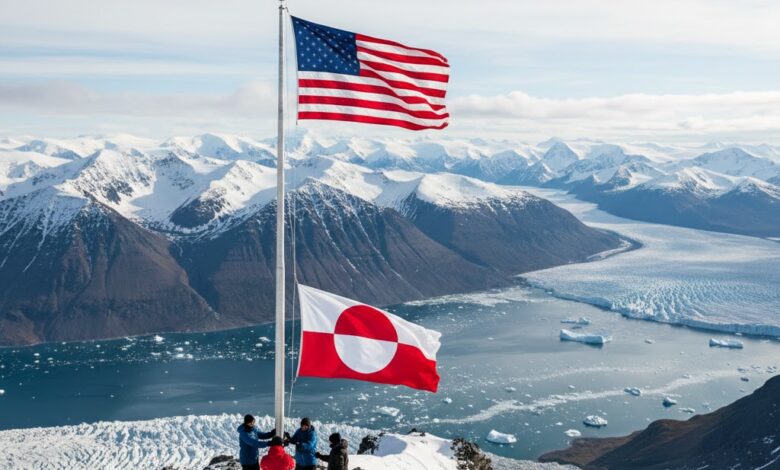
Greenland and the Geometry of Power. Understanding Greenland’s strategic importance requires abandoning the Mercator map—a projection that distorts distances and misleads perceptions of global geography. When viewed correctly, from a polar or great-circle perspective, Greenland emerges not as a remote Arctic landmass but as a central node in global security dynamics.
Russia’s strategic military infrastructure is concentrated on the Kola Peninsula, near Finland. This region hosts Russian ICBM fields, ballistic-missile submarine bases, and strategic bomber forces—the core of Moscow’s nuclear deterrent.
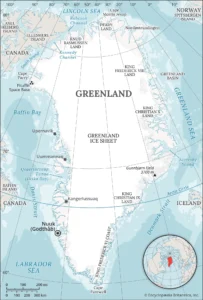
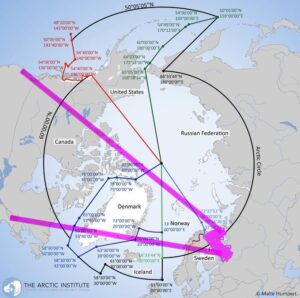
When plotted on a realistic globe, the shortest flight paths from Kola to targets in the continental United States do not arc across Europe or the Atlantic in the way Mercator suggests. They pass directly over the Arctic—and over Greenland. In any nuclear exchange, ballistic missiles follow great-circle trajectories. The most effective point to intercept such a missile is near its apogee, the highest point of its flight path.
By – Dr. Namrata Mishra Tiwari, Chief Editor http://indiainput.com
Given the physics of missile trajectories and the limits of response time, the optimal place to reach that apogee is from directly beneath it. Greenland occupies precisely that position. It is not symbolic real estate; it is a geographic fact.
Greenland – As viewed from a proper map
Why Greenland? Well because Moscow bases almost all of their strategic military assets on the Kola Peninsula next to Finland. This is where the Russian ICBM silos, submarine bases, and their strategic bombers are.
If you look at the… pic.twitter.com/z6qECCJ3u5
— Object Zero (@Object_Zero_) January 6, 2026
This alone explains why U.S. missile-warning radars, space-tracking systems, and early-warning infrastructure have long existed in Greenland. The island is not peripheral to North American defense—it is central to it.
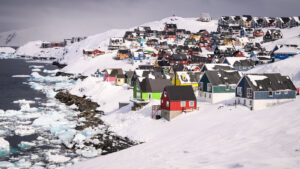
A second strategic shift is now accelerating Greenland’s importance: the opening of the Northern Sea Route. As Arctic ice retreats, cargo ships—particularly Chinese—will increasingly travel between Asia and Europe via the Arctic, shaving time off routes constrained by the Suez Canal. Where commerce goes, naval presence follows. Submarines do not respect shipping lanes, and Chinese under-ice operations in the Arctic are no longer speculative.
There’s almost nothing along the rest of that coast. It’s practically inaccessible and inhospitable.
It’s just a big death zone. Station your military personnel there and they might just die. Station equipment there and you will probably never see it again.
The oilfields in… pic.twitter.com/qKUXBFTWmd
— Object Zero (@Object_Zero_) January 6, 2026
This places the northeastern coast of Greenland at the intersection of two security imperatives: ballistic missile defense and Arctic maritime surveillance. Few locations on Earth serve both roles simultaneously.
War on Drugs or War of Deception?
Strategic Autonomy Isn’t a Slogan: Why Pokhran Still Matters
Strategic Autonomy Isn’t a Slogan: Why Pokhran Still Matters
भाषाओं का बढ़ता ‘वायरस’ : अस्मिता और प्रशासन की जंग।
What Really Makes a Year “New”? India’s Time Explained