Sacred⚖️Sovereignty: End of Government Grip on Hindu Shrines
As the Supreme Court nears its April 22 deadline, the Union’s call for zero oversight marks a historic shift in India’s secular landscape.

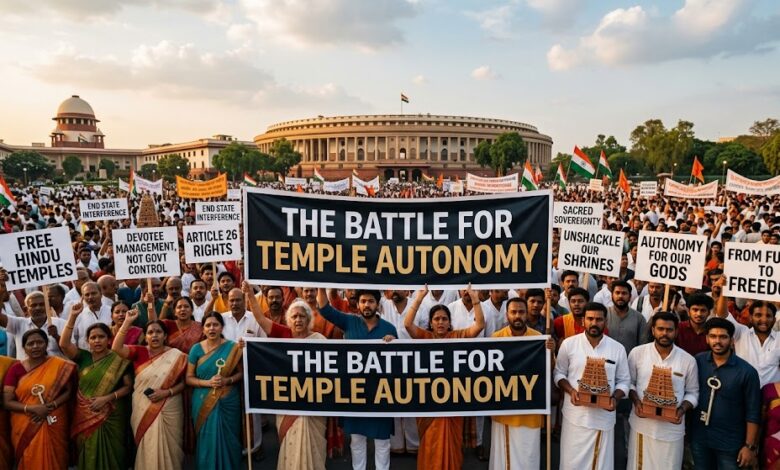
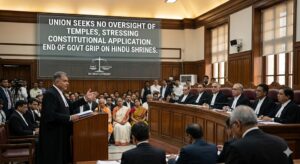
Sacred Sovereignty: End of Government Grip on Hindu Shrines. ⚖️In a significant legal clarification before the Supreme Court, Solicitor General Tushar Mehta informed a nine-judge Constitution Bench that the Union government has no intention of seeking oversight or control over the administration of temples.
This statement, delivered on Tuesday, serves as a pivotal counter-narrative to long-standing claims that the state seeks to maintain or expand its grip on Hindu religious institutions.
By_ https://indiainput.com Desk
⚖️Separation of Sanctuary
The remarks were made during an intensive review of the legal framework surrounding religious freedom, a process triggered by the 2018 Sabarimala verdict.
The core of the debate rests on the delicate equilibrium between Article 25, which guarantees the freedom to practice religion, and Article 26, which protects the right of religious denominations to manage their own affairs, all while ensuring these rights do not infringe upon constitutional guarantees of equality.
BIG NEWS 🚨 Modi Govt tells Supreme Court that it doesn’t want to control temples at all. pic.twitter.com/i8mqaCZNoj
— News Algebra (@NewsAlgebraIND) April 22, 2026
⚖️The Constitutional Tug-of-War
The Solicitor General emphasized that the Constitution must be applied uniformly across all faiths. This address comes at a time when the disparity in religious management is under intense scrutiny. Currently, states such as Tamil Nadu and Kerala manage thousands of Hindu temples through various Hindu Religious and Charitable Endowments boards. In contrast, mosques and churches in India remain largely autonomous, governed by their own internal structures or specific central acts like the Waqf Act, which offer a different degree of state intervention.
For decades, many devotee groups and legal scholars have argued that state management of temples has led to:
-
Systemic Mismanagement: Allegations of bureaucratic inefficiency in daily rituals and heritage conservation.
-
Fund Diversions: Concerns that temple offerings are redirected toward non-religious administrative costs or state projects.
-
Erosion of Autonomy: The feeling that the community of believers has been sidelined in favor of government-appointed officials.
🚨 HUGE! SC again questions Sabarimala Practices
— Court REPEATEDLY questions bar on devotees TOUCHING the deity.Asks if birth-based restrictions can override FUNDAMENTAL RIGHTS. Direct challenge 😳
Court pushes if such traditions need Constitutional Protection, or be STRUCK… pic.twitter.com/J2jPPJKo3A
— The Analyzer (News Updates🗞️) (@Indian_Analyzer) April 22, 2026
⚖️Redefining Religious Freedom
The Union’s stance highlights a push toward a more “hands-off” approach, suggesting that religious institutions should ideally be managed by the devotees and denominations themselves, provided they adhere to the fundamental laws of the land. By stating that the government seeks no oversight, Mehta signaled a preference for the autonomy of the shrine over the authority of the state.
As the nine-judge bench prepares to conclude hearings around April 22, the legal community is watching closely. The eventual ruling will likely redefine the boundaries of state intervention. If the court aligns with the sentiment of religious autonomy, it could pave the way for a monumental shift in how Hindu endowments are managed across the country, potentially moving toward a model that mirrors the independence enjoyed by other faiths in India.
The verdict will not just be about Sabarimala; it will be a landmark blueprint for the future of secularism and religious management in the world’s largest democracy.
SOURCE :
FEEDBACK : contact@indiainput.com
CATCHUP FOR MORE ON : https://indiainput.com
Maharashtra Ends School-Shop Monopoly: Major Win for Parents