

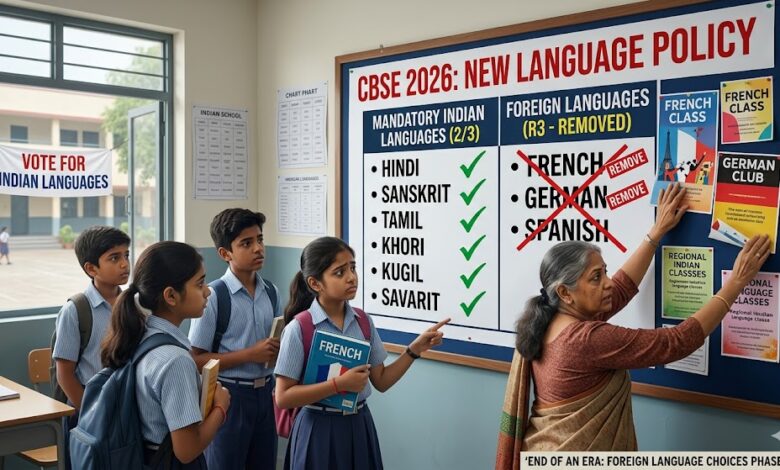
CBSE 2026: The End of the Foreign Language Elective? The landscape of Indian schooling faced a significant tremor this week as the Central Board of Secondary Education (CBSE) announced a high-severity shift in its language policy. In a move that has sent shockwaves through classrooms across the country, new regulations mandate that students must now study three languages, with a strict requirement that two of these must be native Indian languages. While English remains a staple as the third option, the future of popular foreign electives like French, German, and Spanish is suddenly shrouded in doubt.

The Structural Change
According to recent reports, the policy aims to anchor the education system more firmly in regional and national roots. Under the new framework, the flexibility that allowed students to swap a secondary Indian language for a global one has been tightened.
Schools that previously marketed themselves on their robust international language departments are now scrambling to adjust their teaching plans.
http://
🚨 New language rule in Central Board of Secondary Education 🇮🇳
From 2026–27, Class 6 students must study 3 languages
📚 At least 2 must be Indian languages (8th Schedule)
🌍 English allowed, but foreign languages like French/German limited in core
A major shift in school… pic.twitter.com/UQwedgsD29— Infra Talks (@InfraTalksYT) April 22, 2026
Why the Alarm?
The “High” severity rating of this news stems from the suddenness of the implementation. For years, Indian students have utilized foreign language proficiency as a bridge to global career opportunities and higher education abroad.
By removing these choices from the core curriculum, critics argue that the board is inadvertently narrowing the global competitiveness of the next generation.
-
Career Constraints: Parents are voicing concerns that losing early exposure to European or East Asian languages will put Indian students at a disadvantage in an increasingly interconnected global economy.
-
Logistical Chaos: Schools are now faced with the task of hiring new faculty for Indian regional languages while potentially phasing out dedicated foreign language staff.
A Failure in Transition
What went wrong? The primary critique lies in the lack of a clear transition plan. There is currently no definitive answer on how this affects students who are already halfway through their middle or high school journey.
A gradual shift, perhaps keeping foreign languages as optional vocational credits, might have balanced the policy goals with student needs. Instead, the sudden shift has left many feeling that global skills are being sacrificed for administrative uniformity.
Public Advisory
As the dust settles, parents and students are advised to:
-
Consult School Boards: Immediately verify which Indian languages your specific school will offer.
-
Evaluate Private Coaching: If a foreign language is vital for future study-abroad plans, look into external certifications like the DELF (French) or Goethe-Institut (German).
-
Monitor Official Updates: Look for clarification on whether these languages can still be taken as “hobby” or “additional” subjects.
The bottom line remains a question of balance. While fostering Indian languages is a noble cultural goal, the modern student requires a toolkit that includes both their roots and the wings to fly globally.
SOURCE :
FEEDBACK : contact@indiainput.com
CATCHUP FOR MORE ON : https://indiainput.com
Maharashtra Ends School-Shop Monopoly: Major Win for Parents