

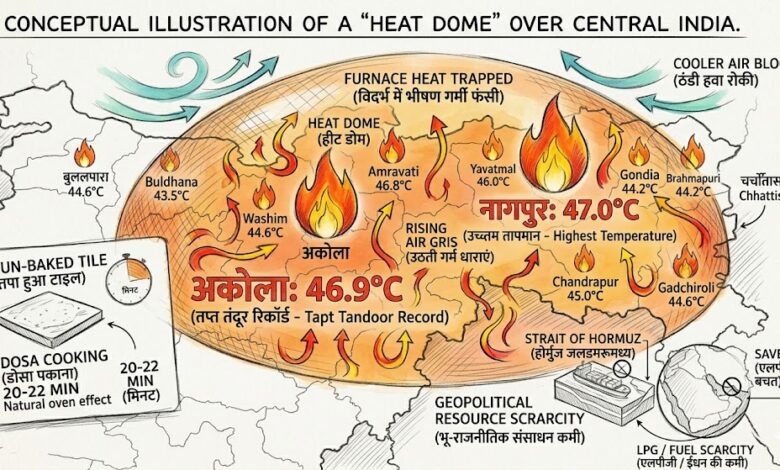
Heatwave : Vidarbha’s “Heat Dome” & Global Resource Crunch. The heart of India i.e Central India is currently pulsating with a heat so intense it has transitioned from a weather headline to a survival challenge. On April 27, 2026, the city of Nagpur touched a blistering 45.6°C, while Akola maintained its status as the nation’s “tandoor” at 46.9°C.
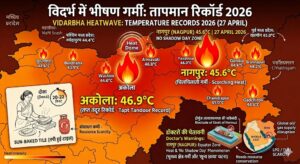
This isn’t just a seasonal spike; it is the manifestation of a “Heat Dome”—a meteorological phenomenon where high-pressure systems trap hot ocean air like a lid on a pot, sizzling everything beneath it.
BY_ http://indiainput.com Desk
http://
The Dosa Test: Nature’s Stove
In a viral testament to this extreme climate, an Akola resident successfully cooked a dosa on a stone tile using nothing but raw sunlight in just 20 minutes.
While this makes for a startling visual, it underscores a grim reality: the ground temperature is now high enough to cause second-degree burns upon contact.
The Geopolitical Connection: Why Saving Fuel Matters
This surge in temperature coincides with a volatile global backdrop. The ongoing tensions in the Middle East and the blockade of the Strait of Hormuz have severely disrupted global energy supply chains.
With LPG and fuel prices skyrocketing due to resource scarcity, the “solar-cooked dosa” is no longer just a curiosity—it is a symbolic nod to an era where traditional energy must be conserved at all costs.
Every unit of LPG saved today is a buffer against the escalating International energy crisis.
Health and Economy Under Siege
The streets of Vidarbha resemble a self-imposed lockdown. From 12 PM to 4 PM, economic activity grinds to a halt. Local workers, like auto-rickshaw drivers, report a total loss of afternoon earnings as citizens retreat indoors to escape heat strokes.
Medical professionals have issued urgent warnings, noting that the combination of high daytime heat and humid nights is pushing the human body to its psychological limits.
While Nagpur is experiencing an extreme heatwave with temperatures reaching 45.6°C on this April 27, 2026, there are a few geographical nuances to clarify regarding why the city gets so hot and the phenomenon of “No Shadow Day.”
Geographical Facts vs. Myths
-
The Equator Myth: Contrary to popular belief, the Equator does not pass through Nagpur. The Equator stays at $0^\circ$ latitude. Nagpur is located at approximately $21.14^\circ$ N latitude. However, the Tropic of Cancer ($23.5^\circ$ N) passes just north of the region (near Jabalpur), placing Nagpur deep within the tropical zone.
-
The Zero Shadow Day (ZSD): You are correct that Nagpur witnesses a Zero Shadow Day, but it doesn’t happen today. For Nagpur, this typically occurs around May 26 and again in July.
-
What is ZSD? It is a phenomenon where the Sun is exactly at the zenith (the highest point in the sky directly overhead), causing vertical objects to cast no shadow for a few moments. This happens twice a year for locations between the Tropics.
Why Nagpur is a “Tandoor” in 2026
The current temperature of 45.6°C is driven by more than just its tropical location. Several factors are converging to create this “furnace” effect:
1. The Heat Dome Phenomenon
As seen in recent weather patterns, a Heat Dome has settled over Vidarbha. This occurs when a persistent region of high pressure traps heat near the ground, acting like a lid on a pot. The air sinks and compresses, which warms it even further, preventing clouds from forming and allowing the sun to beat down relentlessly.
2. Continentality (Land-Locked Effect)
Nagpur is located in the precise center of the Indian peninsula. Being far from the cooling influence of the oceans, the land heats up rapidly. Without sea breezes to regulate the temperature, the dry heat accumulates, leading to the extreme spikes we see today.
3. Urban Heat Island (UHI)
The rapid urbanization of Nagpur—more concrete, asphalt, and fewer green cover—absorbs and radiates heat. This makes the city several degrees warmer than the surrounding rural areas of Vidarbha.
Safety Advisory: Orange Alert
With the mercury crossing 45°C, the health risks are significant.
-
Hydration: Drink water even if you don’t feel thirsty.
-
Peak Hours: Avoid the sun between 12:00 PM and 4:00 PM.
-
Energy Conservation: As global energy resources face pressure due to the Strait of Hormuz situation, minimizing power wastage during peak heat hours helps stabilize the local grid.
The “No Shadow Day” might be a month away, but the sun is certainly making its presence felt today.
SOURCE :
https://mausam.imd.gov.in/imd_latest/contents/
FEEDBACK : contact@indiainput.com
CATCHUP FOR MORE ON : http://indiainput.com
Sacred⚖️Sovereignty: End of Government Grip on Hindu Shrines