
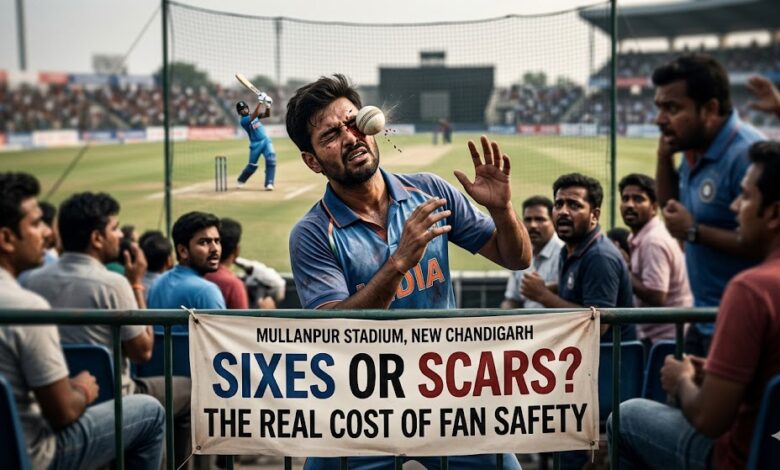
Sixes or Scars? The Real Cost Of Fan Safety. The crack of the bat is usually a sound of celebration, but at the Maharaja Yadavindra Singh International Cricket Stadium in New Chandigarh, it recently became a herald of horror. During an IPL 2026 match between Punjab Kings and Rajasthan Royals on April 28, a powerful six from batter Priyansh Arya struck an elderly spectator directly in the face.
The resulting images—of a man bleeding profusely and being rushed for medical aid—have ignited a fierce debate: are our stadiums actually safe for the fans who fill them?
BY_ http://indiainput.com Desk
The Small Ground Liability
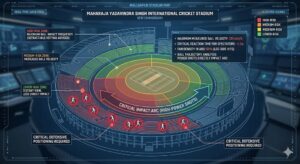
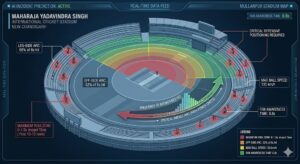
New Chandigarh’s stadium is a modern marvel, but its compact design—meant to bring fans closer to the action—has created a “high-velocity trap.” On small grounds, a ball can reach the stands in under 1.5 seconds, often traveling at speeds exceeding 120 km/h. This leaves zero room for error and zero time for reaction.
🚨 BIG INJURY IN PBKS FAN’S !😭😲
– Priyansh Arya hits a shot, and the ball goes beyond the boundary and strikes an elderly man in the eye. Blood immediately starts coming out of his eye, and as the bleeding does not stop, he is taken to the hospital right away pic.twitter.com/AciRYAbjZW
— lndian Sports Netwrk (@IS_Netwrk29) April 28, 2026
The Spectator’s Shield: A Split-Second Survival Guide
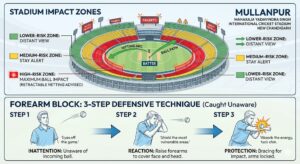
In a compact stadium, a cricket ball can reach the stands in less than two seconds, often traveling at speeds exceeding 120 km/h. When caught unaware, a spectator’s natural instinct is to freeze, but proactive “shielding” is essential:
View this post on Instagram
-
The Forearm Block: If the ball is coming at your face or chest, bring both forearms up to cover your head, tucking your chin into your chest. It is better to take a bruise on the arm than a fracture to the skull.
-
The “Turn and Tuck”: If you cannot track the ball, turn your back to the field and crouch. This protects your eyes, nose, and teeth—the most vulnerable impact points.
-
Peripheral Awareness: Safety starts with the eyes. Fans in the “danger zones” (long-on, long-off, and mid-wicket) must minimize phone distractions during live play.
A Call for Organiser Accountability
While fans must stay alert, the burden of safety lies with the Punjab Cricket Association and IPL organizers. The “intimacy” of a small ground should not be a death trap.
-
Protective Netting: Many global venues use retractable, high-visibility spectator netting in high-risk lower tiers. These nets absorb the energy of the ball without ruining the view.
-
Strategic Warning Systems: Beyond static signs, stadiums need digital “Hot Zone” alerts on big screens that flash when a high-velocity hit is heading toward a specific section.
-
Medical Access Parity: Reports from the Mullanpur incident highlighted the chaos of traffic mismanagement, which can delay ambulances. Organizers must ensure dedicated medical corridors are never blocked by VIP movement or illegal parking.
Conclusion
As T20 cricket evolves with heavier bats and shorter boundaries, the “small ground” charm is becoming a liability. If stadiums in New Chandigarh want to host world-class cricket, they must implement world-class safety. No fan should go to a match to support their team and leave in an ambulance.
Cricket is a game of passion, but that passion should never cost a life. It is time for the Punjab Cricket Association to ensure that the only things hitting the stands are memories, not medical emergencies.
SOURCE :
https://www.punjabkingsipl.in/
FEEDBACK : contact@indiainput.com
CATCHUP FOR MORE ON : http://indiainput.com