The Evolution of Tiranga: A Flag That Carries India’s Story
The Tiranga is more than a flag—it is a visual chronicle of India’s journey to independence.

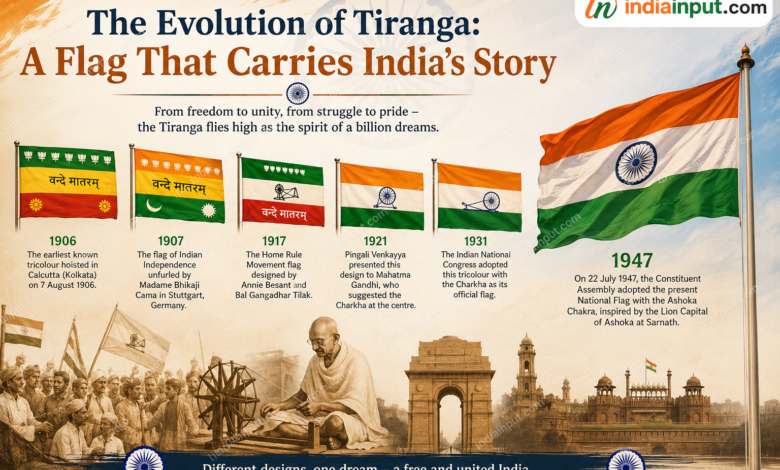
The Evolution of Tiranga: A Flag That Carries India’s Story. From the early banners of India’s freedom struggle to the National Flag adopted on 22 July 1947, the Tiranga has travelled through a remarkable journey of ideas, movements and sacrifices. More than a national symbol, it represents India’s aspirations, unity and hard-won freedom.
By_https://indiainput.com Desk
The First Steps: 1906 and 1907
The story of India’s national flag is often traced to 7 August 1906, when an early tricolour was reportedly hoisted at Parsee Bagan Square in Calcutta, now Kolkata. Its design featured green, yellow and red bands, along with symbols associated with India’s national awakening.
In 1907, Madame Bhikaji Cama and her associates displayed another version of the flag in Stuttgart, Germany. Often called the “Flag of Indian Independence,” it carried symbols representing India’s struggle against British rule and took the message of Indian independence to an international audience.
Tracing the Evolution of the Tiranga 🇮🇳
🔸From the earliest flags of India’s freedom movement to the Tricolour adopted as our National Flag in 1947, every colour, symbol and design tells a story of sacrifice, courage, unity and hope.
🔸Discover the remarkable journey of the… pic.twitter.com/gbVOtLW9ZL
— PIB India (@PIB_India) August 11, 2026
Gandhi, the Charkha and a New Identity
As the freedom movement gathered momentum, the flag evolved alongside India’s political awakening. In 1921, Pingali Venkayya presented a flag design to Mahatma Gandhi. Gandhi suggested the inclusion of the spinning wheel, or Charkha, as a symbol of self-reliance, dignity of labour and the Swadeshi movement.
The flag gradually became an important emblem at Congress meetings and during mass movements against colonial rule.
The 1931 Tricolour
A major milestone came in 1931, when the Indian National Congress adopted a saffron, white and green flag with the Charkha at its centre. This design was not yet the National Flag, but it became an important predecessor to the modern Tiranga.
The three colours increasingly came to represent ideals associated with India’s freedom struggle rather than religious communities.
The Tiranga We Know Today
On 22 July 1947, the Constituent Assembly adopted the present National Flag of India. The Charkha was replaced by the Ashoka Chakra, a navy-blue wheel with 24 spokes, inspired by the Lion Capital of Ashoka at Sarnath.
The final design features saffron at the top, white in the middle and green at the bottom, with the Ashoka Chakra at the centre.
More Than a Flag
Today, the Tiranga flies above government buildings, schools, homes and public spaces across India. It has accompanied the nation through celebrations, challenges and historic achievements.
Every time it rises, it recalls the sacrifices of the freedom struggle—and reminds us that the Indian story is built on courage, unity, duty and hope.
SOURCE :
http://flagfoundationofindia.in
CATCHUP FOR MORE ON : https://indiainput.com