UPI Made Money Move in Seconds. So Do Scams
India’s digital payment revolution has brought unprecedented convenience—and an urgent need for financial awareness.

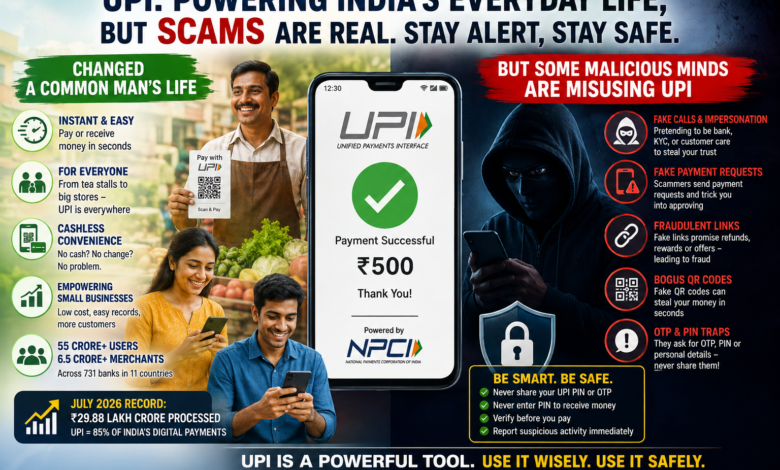
UPI Made Money Move in Seconds. So Do Scams. India’s Unified Payments Interface (UPI) has transformed the way ordinary Indians handle money. Launched in April 2016, what began as a relatively unfamiliar digital payment system has become part of everyday life—from roadside tea stalls and vegetable vendors to taxis, restaurants and online shopping.
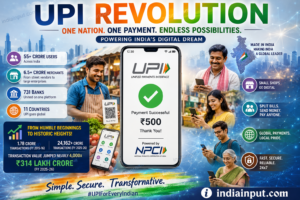
By FY 2025-26, UPI had crossed 24,162 crore transactions, processing an extraordinary ₹314 lakh crore. With hundreds of millions of users and millions of merchants, it has become one of India’s most visible digital success stories.
By _ Dr. Namrata Mishra Tiwari, Chief Editor,https://indiainput.com
From Cash in Pocket to Phone in Hand
For the common man, UPI has made payments faster, simpler and more accessible. There is no need to carry exact change, search for an ATM or hand over cash for every small purchase. A smartphone and a UPI app can turn even a tiny shop into a digital payment counter.
For small businesses, the impact is equally significant. A QR code can replace expensive payment infrastructure, while digital transaction records can make it easier to track income and expenses. For customers, instant confirmation provides convenience and transparency.
A decade ago, UPI was rolled out, marking a major turning point in India’s digital payments journey.
The sheer scale and reach of UPI are something every Indian must be proud of.
Tell me about your UPI experience and how it impacted your life… #10YearsOfUPI pic.twitter.com/Xtto6V6gpU
— Narendra Modi (@narendramodi) August 25, 2026
A Digital Lifeline for Everyday India
UPI has also changed social habits. Splitting a restaurant bill, sending money to family, paying school-related expenses, buying groceries or settling a local service bill can now take seconds.
Its biggest achievement may be that digital payments no longer feel exclusively urban or elite. The humble QR code has become a familiar sight across India’s streets and markets.
But Convenience Has a Dark Side
The same simplicity that makes UPI powerful can also be exploited by malicious actors. Scammers increasingly rely on social engineering rather than sophisticated hacking. They may impersonate bank officials, customer-care representatives, delivery agents or government personnel and manipulate victims into revealing sensitive information or approving transactions.
Fake payment requests, fraudulent QR codes, deceptive links and bogus refund offers can turn a moment of trust into a financial loss.
The Golden Rule: Receiving Money Doesn’t Need a PIN
One of the most important lessons for UPI users is simple: never enter your UPI PIN merely to receive money. A PIN is used to authorise payments, not to accept them.
Users should also avoid sharing OTPs, UPI PINs or banking credentials, and should verify unexpected payment requests before approving anything. A caller creating urgency—“your account will be blocked,” “your refund is waiting,” or “pay immediately”—should be treated with suspicion.
UPI’s Next Challenge: Trust
UPI has changed the common man’s relationship with money by making payments almost effortless. But that convenience demands digital awareness. Technology can make a transaction instantaneous; it cannot automatically determine whether the person on the other side is honest.
The future of UPI, therefore, is not merely about processing more transactions. It is about ensuring that speed never comes at the cost of safety. India has built a world-class digital payment ecosystem. The next revolution must be making every user smart enough to use it securely.
SOURCE :
http://www.digitalindia.gov.in
http://financialservices.gov.in
FEEDBACK : Contact@indiainput.com
CATCHUP FOR MORE ON : https://indiainput.com
Tukaram Mundhe’s Food-Safety Streak: No Pests. No Compromise.