
Tiny Chips, Giant Future: From Silicon to Smart Devices
How Ashwini Vaishnaw is making semiconductor technology easy for young minds

Tiny Chips, Giant Future: From Silicon to Smart Devices. What makes a smartphone smart? How does a computer process information? How can a car, television or satellite perform thousands of tasks? Behind many of these technologies is a tiny but powerful component called a semiconductor chip.
Union Minister Ashwini Vaishnaw has increasingly used simple explanations to introduce young people to the world of semiconductors. His approach is important because chips may look incredibly complicated, but their basic purpose can be explained in surprisingly simple ways.
By _ Dr. Namrata Mishra Tiwari, Chief Editor https://indiainput.com
What Exactly Is a Semiconductor?
Imagine electricity as traffic moving along a road. Sometimes we want the traffic to move, and sometimes we want it to stop.
A semiconductor is a special material that allows engineers to control the movement of electricity. Silicon is the most commonly used material for making semiconductor devices.
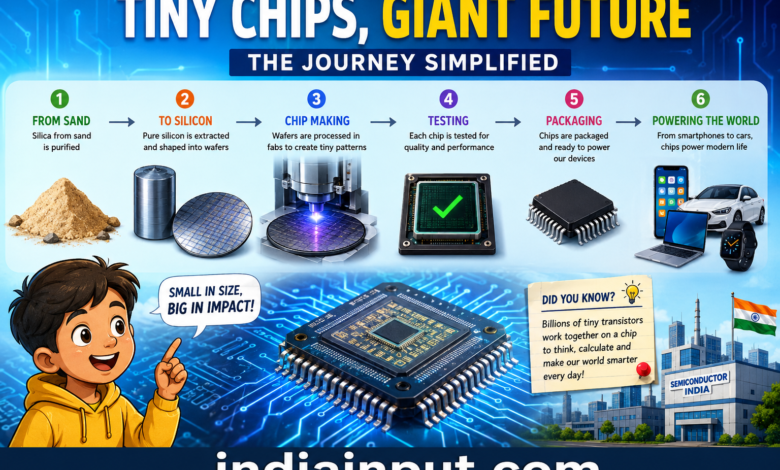
The chip journey, simplified. pic.twitter.com/dZIqkX5QvR
— Ashwini Vaishnaw (@AshwiniVaishnaw) August 31, 2026
Engineers use this ability to create transistors—tiny electronic switches. Billions of these switches can work together inside a modern chip.
That is how a tiny piece of silicon can perform calculations, store information and control electronic devices.
From Sand to Silicon
Here comes the fascinating part.
Silicon is obtained from materials containing silica, which is abundant in nature. After extremely careful purification, it can be turned into silicon wafers.
These wafers are processed in highly controlled factories called fabs, short for fabrication facilities.
On these wafers, engineers create incredibly tiny electronic structures. The finished chips are then tested and packaged before being used in electronic products.
Why Do Chips Matter?
Think about your phone. Its processor helps run apps, cameras, games and communication. Cars use chips for safety systems and controls. Satellites, medical equipment, computers and artificial-intelligence systems also depend on semiconductors.
That is why semiconductors are often described as the building blocks of the digital age.
Why Should Students Learn About Chips?
The semiconductor industry is not only about factories. It needs scientists, engineers, programmers, designers, researchers and technicians.
India is expanding its semiconductor ecosystem across chip design, manufacturing, packaging, testing, equipment, research and talent development. The government has also highlighted the importance of building semiconductor skills among students and engineers.
A Tiny Chip, A Giant Future
The biggest lesson for children is simple: size does not determine importance.
A chip smaller than a coin can help power technologies used across the world. By explaining semiconductors in simple, visual and relatable language, Vaishnaw is helping young minds understand the technology behind their everyday devices—and perhaps inspiring the next generation of Indian chip designers and engineers.
Source :
FEEDBACK : Contact@indiainput.com
CATCHUP FOR MORE ON : https://indiainput.com