Fashion vs Festival: The GIVA Raksha Bandhan Ad Debate
When creative freedom collides with the cultural and emotional significance of Raksha Bandhan.

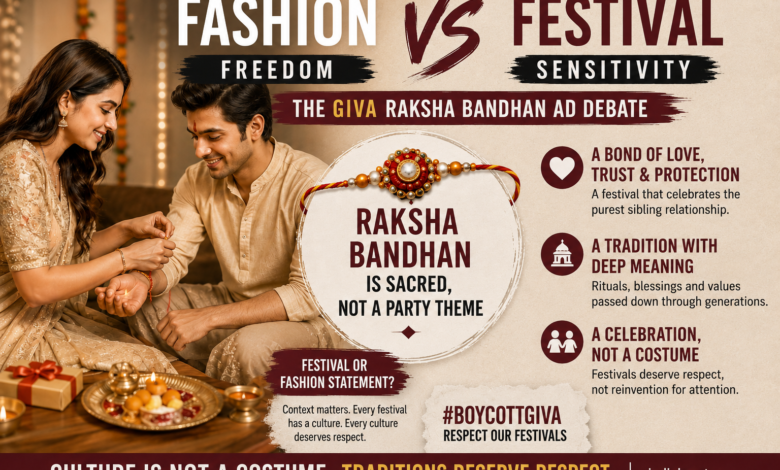
Fashion vs Festival: The GIVA Raksha Bandhan Ad Debate. Raksha Bandhan is not merely another festive occasion on the advertising calendar. It is a deeply rooted Indian tradition celebrating the bond of affection, trust and support between siblings. The tying of the rakhi carries emotional and cultural significance that goes far beyond jewellery, fashion or commercial gifting.
That is precisely why GIVA Jewellery’s recent Raksha Bandhan campaign featuring Kriti Sanon triggered such a strong reaction. The advertisement, released on July 20, showed Sanon in an Indo-Western outfit comprising a bralette-style blouse, cape and draped skirt while celebrating Raksha Bandhan.
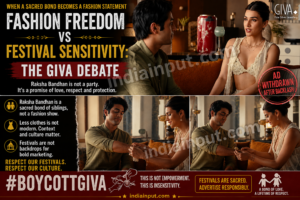
Critics argued that the styling was out of step with the setting and symbolism of the festival.
By _ https://indiainput.com Desk
Modern Does Not Have to Mean Revealing
The larger debate is not simply about a woman’s clothes. Women should have agency over what they wear, and empowerment cannot reasonably be reduced to policing a neckline.
But the reverse is also worth asking: does empowerment have to be communicated through revealing clothing?
Giva Jewellery delivered a complete miss on their Raksha Bandhan Jewellery ad. Less clothes doesn’t mean modern. Less clothes isn’t women empowerment! That’s a lie being sold. Wear the appropriate outfit at the appropriate time. This would have made sense for an ad on a club, not… pic.twitter.com/LBwR5yk9p7
— Sᴜᴢᴀɴɴᴇ Bᴇʀɴᴇʀᴛ (@suzannebernert) August 24, 2026
There is nothing inherently modern about wearing less, just as there is nothing inherently regressive about choosing traditional clothing. Context matters. A fashion campaign for a nightclub, beach holiday or evening party can have an entirely different visual language from an advertisement built around a sacred family festival.
The criticism, therefore, is less about demanding one particular dress code and more about asking whether advertisers understand the cultural context in which they are selling.
Even from my ‘liberal,grown up in Germany’ mindset this is way off. It’s a beautiful festival with deep meaning. This looks like ‘chalo, let’s go party!’ https://t.co/0ZZaWRIwLM
— Sᴜᴢᴀɴɴᴇ Bᴇʀɴᴇʀᴛ (@suzannebernert) August 24, 2026
When Cultural Context Gets Lost
Raksha Bandhan traditionally carries an intimate family atmosphere—rakhis, tilak, sweets, blessings and siblings celebrating their relationship. For many Indians, these rituals are emotionally sacred.
That does not mean every participant must dress identically or follow a rigid template. But when an advertisement invokes a culturally significant festival, the creative team has a responsibility to understand what the occasion represents.
A campaign can be contemporary without making the festival look like a party-night fashion shoot.
The Backlash Became Bigger Than the Advertisement
The controversy intensified after Kriti Sanon defended the campaign, arguing that culture and tradition are not determined by a woman’s neckline. That response opened a wider conversation about women’s autonomy, cultural expectations and whether criticism of an advertisement automatically amounts to moral policing.
There are legitimate arguments on both sides. Women should not be shamed for their clothing. At the same time, consumers are entitled to question whether commercial representations of religious and cultural festivals are respectful and context-sensitive.
GIVA Eventually Pulled the Campaign
The online backlash ultimately became impossible for the brand to ignore. On August 26, GIVA announced that it had withdrawn the advertisement from all media, saying it holds Indian culture, traditions and festivals in the highest regard and apologising if the campaign had inadvertently hurt sentiments.
The episode is therefore a reminder to advertisers: creative freedom does not eliminate cultural responsibility.
Raksha Bandhan does not need to be made “cool” by borrowing the visual language of a party. Its beauty already lies in something much simpler—the love between siblings.
Modernity can evolve with tradition. It does not have to erase the context that gives a festival its meaning.
SOURCE :
http://www.incredibleindia.gov.in
http://www.indiaculture.gov.in
FEEDABACK : Contact@indiainput.com
CATCH UP FOR MORE ON : https://indiainput.com