The 2026 SMC U-Turn: How the Ministry Backed Down
Inside the private school revolt that forced the government to drop its mandatory 75% parent-committee rule.

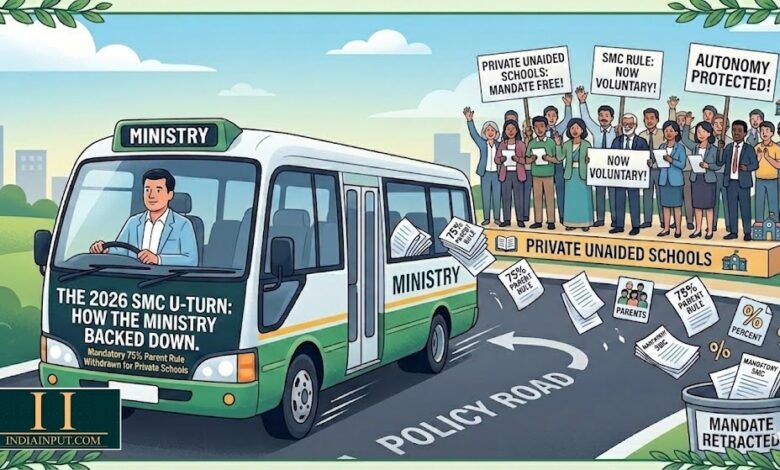
The 2026 SMC U-Turn: How the Ministry Backed Down. The central crisis surrounding the Ministry of Education’s School Management Committee (SMC) Guidelines 2026 was never a simple disagreement over parental involvement. Instead, it was a fundamental clash over private property rights, operational autonomy, and institutional control.

BY_ https://indiainput.com Desk
The Core Conflict: A Clash Over Private Autonomy
At the heart of the dispute was a mandatory provision dictating that 75% of a private school’s management committee must consist of parents. The remaining quarter was to be divided among local administrators, teachers, and community workers.
For private, unaided institutions—which receive zero financial assistance, subsidies, or grants from the state—this structural mandate represented an aggressive, democratic overreach.
Critics argued that the policy effectively stripped school founders, investors, and trustees of their legitimate decision-making power, handing control of private assets over to an external body.
और आज @EduMinOfIndia को यह निर्णय वापस लेना पड़ा। मुझे कई लोगों के कॉल आए कि यदि यह लागू हो गया तो स्कूल बंद होने लगेंगे। पहले SMC की बकलोली हर प्राइवेट स्कूल में हो रही थी, अब इसे केवल सरकारी वित्तपोषित विद्यालयों में (आंशिक या पूर्ण) ही लागू किया जाएगा।
अच्छा है कि सरकार ने… https://t.co/WgiBWhyqxQ pic.twitter.com/OwimPkXVJB
— Ajeet Bharti (@ajeetbharti) May 21, 2026
Sweeping Powers and Local Politics
The real issue ran much deeper than the superficial narrative of controlling arbitrary fee hikes or regulatory non-compliance. Under the original 2026 framework, these parent-dominated committees were granted sweeping operational powers that directly interfered with private financial and administrative dynamics.
The guidelines empowered SMCs to dictate capital deployment, determine teacher salaries, influence hiring or termination decisions, and approve large-scale infrastructure tenders.
Policy analysts pointed out that letting parent bodies award contracts for school buildings, smart classrooms, or laboratory upgrades at Public Works Department (PWD) rates risked introducing local political rivalries, populist demands, and nepotism directly into private school administration.
Micro-managing an entity that relies entirely on private risk capital violated basic free-market tenets. Experts drew parallels to the structural absurdity of creating a mandatory “consumer committee” to dictate the production cost, corporate budget, or retail price of a commercial vehicle.
The Strategic Policy Retreat
Furthermore, the mandate highlighted a stark institutional irony: private schools largely absorb massive student enrollment because the public education system struggles under heavy administrative burdens, where government teachers are routinely pulled into non-educational state duties like censuses and election management.
Instead of strengthening public infrastructure, the mandate sought to socialize the control of highly functional private assets already regulated by boards like the CBSE.
Rollback
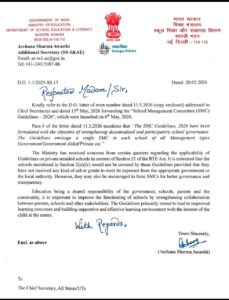
Facing fierce resistance from independent school associations and legal experts who warned of an unprecedented wave of school closures, the Ministry of Education executed a strategic policy retreat.
In a crucial clarification, the Ministry officially retracted the mandate for private unaided schools covered under Section 2(n)(iv) of the Right to Education (RTE) Act, provided they operate without any state or local authority grants.
While the government retreated from legal coercion, it reframed the guidelines as a voluntary roadmap, encouraging schools to adopt collaborative parental oversight to foster ethical governance.
This swift rollback successfully defused an immediate administrative crisis, underscoring the delicate boundary line between state regulation and private enterprise autonomy in India’s educational landscape.
Source :
https://www.education.gov.in/en/
FEEDBACK : contact@indiainput.com
CATCHUP FOR MORE ON : https://indiainput.com